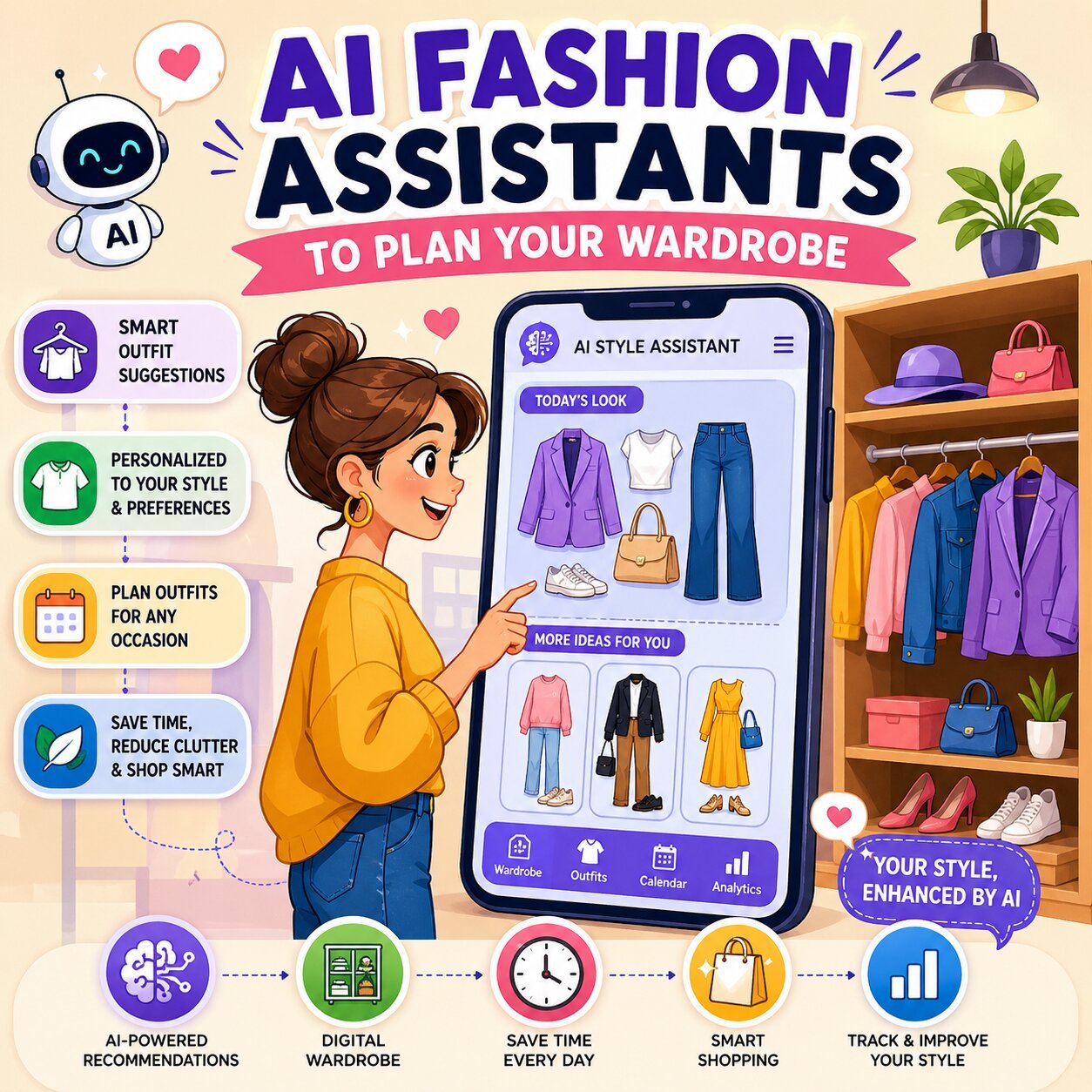
AI Fashion Assistants to Plan Your Wardrobe
Your Closet Is Full — But You Have Nothing to Wear
Sound familiar? You’re standing in front of a wardrobe packed with clothes, and somehow — impossibly — nothing feels right. The clock is ticking. You’re already late. And you end up wearing the same safe outfit you always default to, quietly ignoring the 80% of your closet gathering dust in the dark.
This is not a personal failure. It’s a design problem — and in 2026, AI is finally solving it.
AI fashion assistants to plan your wardrobe have evolved from gimmicky novelty apps into genuinely intelligent daily tools. In 2025, 47 million people used AI-powered fashion apps to plan their outfits. By the end of 2026, that number is projected to surpass 85 million. These aren’t just photo-filtering tools or shopping catalogues with a makeover. They’re personalization engines that learn your wardrobe, your lifestyle, your weather, and your schedule — and then quietly take the morning’s hardest decision off your plate.
This guide covers everything you need: how these tools actually work, which apps are worth your time, the real benefits and honest limitations, what’s coming next, and how to pick the right tool for your unique style life. Whether you’re a capsule wardrobe minimalist or a fashion-forward maximalist, there’s an AI assistant built for you.
Let’s dive in.
What Is an AI Fashion Assistant — And How Does It Actually Work?
Before downloading the first app you find, it’s worth understanding what’s actually happening under the hood. Because “AI-powered” gets slapped on a lot of things that are barely smarter than a random shuffle button.
From Closet Chaos to Digital Wardrobe
The foundation of every AI fashion assistant is the digital wardrobe — a virtual representation of everything you own. You build this by photographing your clothes, and modern apps make this dramatically easier than it used to be. Most now offer automatic background removal, AI-assisted tagging (color, style, season, occasion), and even the ability to import purchase history directly from retailers like Amazon, Zara, or Shein.
Once your items are catalogued, the AI has something real to work with. It can see your full wardrobe the way you can’t when you’re half-awake at 7 a.m. staring into a physical closet.
The Core AI Engines Behind the Apps
Different apps use different AI architectures, but most combine a few key technologies:
- Computer vision — to recognize garment types, colors, patterns, and textures from photos
- Recommendation engines — to suggest outfits using collaborative filtering (what similar users wear) and content-based filtering (what matches within your own wardrobe)
- Machine learning style profiles — advanced wardrobe planners track your dressing patterns, preferred silhouettes, purchase history, climate behavior, and engagement signals like “saved looks” or “ignored suggestions,” building a style profile that adapts continuously over time
- Conversational AI / LLMs — newer apps like Clueless and OpenWardrobe let you literally chat with an AI stylist, asking questions in natural language and receiving personalized outfit guidance in return
What Data Does the AI Use?
The more context an AI fashion assistant receives, the smarter its suggestions become. Most top apps in 2026 tap into:
- Weather data — real-time temperature and forecast integration
- Calendar inputs — syncing your schedule so the AI knows you have a board meeting on Tuesday and a rooftop birthday on Saturday
- Wear history — tracking what you’ve already worn recently to avoid repetition
- Body measurements and color analysis — some apps analyze your skin tone, undertone, and facial features via selfie to determine your most flattering color palette
- Occasion context — formal, casual, business, outdoor, travel
Together, these signals let AI do something surprisingly sophisticated: not just match clothes, but understand why certain combinations work for you, at this moment.
The AI Fashion Assistant Market in 2026 — Why Now?
This isn’t just a consumer trend. It’s a full-scale industry transformation backed by serious investment.
The AI in fashion market grew from $1.75 billion in 2025 to $2.47 billion in 2026 at a CAGR of 40.8%, with projections pointing toward $9.45 billion by 2030. Zooming in specifically on styling and personalization apps — the segment most relevant to individual wardrobe planning — the market was valued at $1.6 billion in 2025 and is expected to hit $10.49 billion by 2033 at a 26.5% CAGR.
Why the explosive growth? A few converging forces:
Consumer demand for personalization. Generic fashion advice no longer cuts it. Over 65% of consumers now interact with AI-personalized styling suggestions weekly, and 48% of Millennials used AI shopping assistants to facilitate their online purchases in 2025.
Sustainability pressure. A Heriot-Watt University study analyzing nearly 6,000 app user reviews confirmed that wardrobe apps reduce overconsumption — users genuinely buy less and wear existing clothes more. When sustainability becomes a consumer priority, apps that help people use what they have become culturally relevant, not just commercially useful.
Post-pandemic digital habit lock-in. The shift to digital-first living cemented mobile commerce and AI tool adoption across demographics. Fashion apps were direct beneficiaries.
The maturation of AI itself. Computer vision, large language models, and personalization algorithms have all made massive leaps since 2022. What was technically clunky three years ago now works well enough to earn genuine daily use.
This is also part of a broader AI lifestyle revolution. Just as AI email assistants now save users hours per week by automating inbox management, AI wardrobe tools are reclaiming the time and mental energy wasted every morning on outfit decisions.
Top AI Fashion Assistants to Plan Your Wardrobe in 2026
Here’s an honest look at the tools leading the space this year — what they do well, who they’re best for, and where they fall short.
Acloset — The AI Closet With a Community
Acloset has quietly become one of the most comprehensive AI wardrobe apps available. With a community of 4 million users, it goes well beyond a simple outfit planner.
The AI picks outfits based on your schedule, weather, and mood — all sourced from your own clothing catalog. It also analyzes your color palette and body type, so suggestions aren’t just stylistically coherent but personally flattering. The “cost-per-wear” tracking feature is a standout: over time, you can see which pieces are genuinely earning their wardrobe real estate and which are just taking up space.
The free plan supports up to 100 wardrobe items, which is enough to test the concept without commitment. Premium plans unlock full digitization for larger wardrobes.
Best for: Everyday AI outfit planning combined with community-driven style inspiration. Limitation: App stability has been a reported issue as recently as April 2026, with some users experiencing crashes. The development team has been responsive, but it’s worth noting.
Clueless — Your AI Stylist Named Katire
Clueless takes a distinctly different and arguably more ambitious approach. Rather than requiring you to painstakingly photograph every garment, you can start with curated style packs — pre-built wardrobe templates that help the AI understand your aesthetic before you’ve uploaded a single item.
The real differentiator is Katire, Clueless’s conversational AI stylist. Katire generates a complete week of outfits from your closet, considering your weather forecast, style preferences, and recent wear history to avoid repetition. And if you have a specific question — “What do I wear to a casual dinner tonight?” or “Help me style this blazer for a creative industry event” — Katire responds with complete outfit suggestions from your actual wardrobe.
The app tracks what gets worn and what sits ignored, feeding that behavioral data back into increasingly accurate future recommendations.
Best for: Users who want hands-off weekly planning with the feel of chatting with a real stylist. Limitation: As a relatively newer entrant, Clueless is still building its feature depth compared to more established competitors.
Whering — The Personalized Fashion Feed
Whering takes its UX cues from social media. After you upload your clothes and build outfits, the AI recommends combinations, highlights items you’re underusing, and delivers visual inspiration calibrated to your tastes — functioning almost like a personalized fashion editorial feed curated from your own wardrobe.
The “Dress Me” feature offers randomized outfit suggestions, and the AI-generated outfit tool creates full looks from your catalog. Whering also integrates packing list features for travel, making it a genuinely versatile wardrobe companion.
The core features are free, which makes it accessible. However, some independent reviews have raised questions about Whering’s long-term business model transparency — worth keeping in mind as a free user.
Best for: Style-curious users who want discovery and inspiration alongside wardrobe organization. Limitation: AI suggestions can occasionally feel disconnected from your personal style, functioning more as novelty than everyday utility.
Indyx — Human Stylist Meets AI Cataloging
Indyx occupies a uniquely premium position in this space: it’s the only wardrobe app that solves the closet digitization challenge with professional cataloging while also offering guidance from real human stylists.
The app includes automatic background removal and AI-assisted tagging, but what sets it apart is that once your wardrobe is catalogued, you can access feedback not just from an algorithm but from actual stylists and trusted contacts. This hybrid model bridges the gap between AI efficiency and human intuition — a gap that, as we’ll discuss shortly, still matters.
Best for: Users who are serious about developing their long-term personal style, not just planning tomorrow’s outfit. Limitation: The setup process is more effort-intensive than most competitors. This is an investment app, not a quick-win solution.
Style DNA — Know Your Colors First
Most wardrobe apps assume you already know what colors work for you. Style DNA starts there.
You take a selfie, and the app’s AI analyzes your facial features to generate a personalized color palette. From that foundation, it suggests clothing items — and lets you shop directly for pieces that complement your natural coloring. It’s a smart entry point for users who feel overwhelmed by fashion decisions because they’ve never understood why some colors make them look vibrant and others make them look washed out.
Best for: Users who want to build style confidence from a solid color theory foundation. Limitation: The color palette suggestions can occasionally feel counterintuitive to your existing wardrobe, requiring additional curation to be practically useful.
Save Your Wardrobe — The Sustainability-First Planner
If your motivation for better wardrobe planning is environmental as much as aesthetic, Save Your Wardrobe is built for you.
This app works as a hybrid wardrobe planner and sustainability assistant. Scan receipts or upload clothing items to track what you own. The platform uses AI to suggest outfits while also tracking how often you wear each piece. In some US cities, it even connects you to cleaning, repair, and tailoring support services — making it genuinely useful for extending the life of your clothes, not just organizing them.
This ties directly into the broader ethical AI trends shaping 2026, where responsible data use and sustainability-aligned technology are becoming non-negotiable expectations.
Best for: Eco-conscious users who want data-driven insights into wardrobe utility and consumption habits. Limitation: Some local services (repairs, tailoring) are geo-limited to select US cities.
OpenWardrobe (LolaAI) — Conversational AI Styling
OpenWardrobe is the most forward-looking app on this list. Rather than navigating menus and tapping through UI, you chat with LolaAI — an LLM-powered styling assistant that understands natural language.
Upload your wardrobe items and then simply ask: “What should I wear to a tech conference next week?” or “I have a first date at a rooftop bar — help.” LolaAI responds with thoughtful, wardrobe-specific suggestions and learns from your interactions over time.
It’s still maturing as a product, but the conversational-first approach represents where all wardrobe AI is heading. Much like how AI chatbots have evolved into genuine virtual companions, AI fashion assistants are moving toward relationship-style interactions — tools you grow with, not just tools you use.
Best for: Early adopters comfortable with conversational AI who want a glimpse of the next generation of wardrobe planning. Limitation: Feature depth still trails more established apps. Worth watching through late 2026.
Quick Comparison: Other Notable Apps
| App | Best For | Standout Feature | Pricing | Weakness |
|---|---|---|---|---|
| Acloset | Community + daily AI planning | Mood/weather/occasion AI | Free / Premium | Stability issues |
| Clueless | Hands-off weekly planning | Chat stylist (Katire) | Free trial / Premium | Newer entrant |
| Whering | Discovery + inspo feed | Personalized fashion feed | Free | Business model questions |
| Indyx | Serious style development | Human stylist + AI cataloging | Free | Setup time investment |
| Style DNA | Color strategy | Selfie-based color palette AI | Free / Paid | Hit-or-miss accuracy |
| Save Your Wardrobe | Sustainability tracking | Usage analytics + care network | Free / Paid | Geo-limited services |
| OpenWardrobe | Conversational AI styling | LLM-based LolaAI chat | Beta | Still maturing |
| Stylebook | Calendar-focused planning | Outfit calendar integration | $2.99/month | UI learning curve |
| Pureple | Absolute beginners | Free with no account required | Free | Very basic AI |
| Glance | Intelligent wardrobe shopping | AI shopping agent | Free | India-focused features |
Real Benefits of Using AI Fashion Assistants (With Data)
Let’s move past the marketing language and look at what these tools actually deliver.
1. Eliminate Morning Decision Fatigue
Decision fatigue is real and scientifically documented. The more choices you make early in the day, the worse your subsequent decisions become. When 80% of a typical closet sits unused and the average person spends 10 minutes every morning in outfit-related indecision, that’s cognitive energy being drained before the workday even begins.
AI wardrobe apps eliminate this entirely. When your outfit is already planned — factoring in weather, calendar, and recent wears — you open the app, see your look, and get dressed. Full stop.
2. Shop Smarter and Spend Less
Here’s a statistic worth sitting with: 30% of new clothing purchases duplicate items people already own. You buy another navy blazer because you forgot you had one. You grab another white shirt because you couldn’t find the one buried in your closet.
AI wardrobe tracking exposes these blind spots with cold, clear data. And the cost-per-wear analytics feature — available in apps like Acloset and Stylebook — reveals which items are genuinely earning their keep versus which expensive purchases have been worn twice and forgotten.
3. Dress Appropriately for Every Occasion Without Overthinking
Weather changes. Meetings appear unexpectedly. Weekend plans shift. AI fashion assistants that integrate with weather data and your calendar handle this dynamically — surfacing rain-appropriate outfits when storms roll in, or helping you pivot from “casual Friday” to “unexpected client presentation” without a wardrobe crisis.
4. Build a More Sustainable Wardrobe
The fashion industry is responsible for approximately 10% of global carbon emissions. One of the most effective personal interventions isn’t buying organic cotton — it’s wearing the clothes you already own more consistently.
Wearing clothing for just nine months longer than average can reduce your fashion carbon footprint by 20–30%. AI wardrobe apps surface forgotten items, highlight your most underused pieces, and reduce the impulse purchasing that fills closets while emptying wallets. This aligns directly with the research showing that wardrobe app users genuinely buy less and wear existing clothes more.
5. Discover Your Actual Personal Style Over Time
Most people think they know their style. But AI wear tracking reveals the truth: there’s often a significant gap between the aesthetic you aspire to and the clothes you actually reach for.
Over weeks and months of tracking, AI builds a style profile based on behavior, not aspiration. The result is increasingly accurate suggestions that reflect who you actually are — and constructive data to help you close the gap between who you are and who you want to be, stylistically speaking.
Honest Limitations — What AI Fashion Assistants Still Can’t Do
No honest review of this space is complete without acknowledging what the technology still gets wrong. EEAT demands balance.
Style Is Deeply Subjective
Fashion is one of the most complex forms of human expression. It carries cultural identity, emotional state, personal history, and social signal all at once. When AI today struggles to understand explicit instructions, expecting it to fully master something as subjective as personal style is still a stretch.
Many users report that AI outfit suggestions feel “close but not quite right” — technically coherent combinations that somehow miss the mark on feel. The AI knows your navy blazer pairs well with grey trousers. It doesn’t know that you hate how you feel in that blazer because of what you were wearing when you got some bad news three years ago.
Closet Digitization Is a Real Friction Point
The biggest drop-off point for new users? Photographing their entire wardrobe. It’s a one-time task that, for larger wardrobes, can take hours. Many people start with enthusiasm and abandon the catalog at 40 items. Apps like Clueless have smartly worked around this with style packs, and some apps offer mirror-selfie scanning — but this remains the category’s most significant UX barrier.
Data Privacy Risks Are Not Trivial
Around 61% of fashion brands report AI implementation challenges due to data privacy concerns. As a consumer, this matters too.
Your wardrobe data, body measurements, color analysis, behavioral patterns, and calendar information are highly personal. Before uploading all of this to any platform, read the privacy policy carefully. Understand what data is shared with third parties, how it’s stored, and what happens if the company is sold or shut down. The ethical AI trends shaping how we use technology in 2026 are directly relevant here — privacy-aware AI usage is no longer optional awareness.
Body Diversity Gaps Still Exist
Most AI fashion models have been trained on limited body-type datasets, which means suggestions for plus-size users, non-binary users, or users from non-Western cultural fashion contexts can be noticeably less accurate or culturally tone-deaf. This is an industry-wide problem being actively worked on, but it’s not solved in 2026.
It’s a Tool, Not a Stylist
AI stylists do not yet offer the same level of personalization as top human personal stylists, who also have access to designer pieces, deep relationship context, and the ability to read emotional cues that no app has yet cracked. If you’re dressing for a pivotal life moment — a wedding, a high-stakes interview, a first date that matters — an AI app is a starting point, not a replacement for genuine human expertise.
How AI Fashion Assistants Fit Into Your Broader AI-Powered Life
One of the most exciting things about AI wardrobe planning in 2026 is how naturally it integrates with other AI tools that are already transforming daily life.
Think about how AI analytics tools help small businesses make data-driven decisions by identifying patterns in behavior and predicting optimal outcomes. AI fashion assistants do exactly the same thing for your personal style — tracking patterns in what you wear, predicting what you’ll reach for, and optimizing your wardrobe’s “performance.”
Similarly, the personalization engines powering outfit recommendations use the same fundamental machine learning loops as the platforms helping creators write AI-optimized video scripts for YouTube and TikTok: input behavioral data, learn preferences, generate personalized output, refine with feedback.
For content creators specifically — especially fashion and lifestyle creators — these tools create a powerful workflow. You can plan and photograph outfits with AI assistance, then use AI video editing tools to produce polished content. The same AI-first mindset that’s transforming online skill building applies here: leverage technology to free up your creative energy for higher-order decisions.
Virtual Try-On Technology — The Next Layer of AI Wardrobe Planning
If AI wardrobe planning is about optimizing what you already own, virtual try-on is about smarter acquisition of what you don’t — and in 2026, this technology has made a significant leap toward everyday usability.
By 2026, AI models can analyze personal dimensions captured from simple smartphone videos and synchronize them with digital garment libraries to visualize real-time fabric behavior. Shoppers can preview how a dress drapes, how jeans fit at the waist, and how lighting affects color perception — without entering a store or waiting for a delivery they’ll likely return.
The most significant signal of virtual try-on’s maturation? Google’s experimental Doppl try-on app — which allowed users to upload a photo and try on outfits from multiple sources — is being shut down as a standalone product not because it failed, but because Google is folding the technology directly into its search infrastructure. Virtual try-on will soon be accessible on product listings and apparel image search results across Google. This move signals that the technology has crossed from “interesting feature” to “basic consumer expectation.”
Meanwhile, luxury brands are leading in experiential integration. Gucci’s AI-powered Snapchat lenses (reported February 2026) let users virtually try on pieces as part of the ad experience itself — blurring the line between advertising and interactive shopping.
The virtual try-on market is projected to grow from $1.2 billion in 2022 to $8.5 billion by 2030, reflecting how foundational this technology is becoming to the entire online fashion ecosystem.
For an in-depth look at the broader landscape of responsible technology adoption as these tools mature, McKinsey’s State of Fashion Technology report remains one of the most authoritative resources available.
The Future of AI Fashion Assistants — What’s Coming 2026 and Beyond
The tools available today are impressive. What’s on the horizon is genuinely transformative.
Generative AI Enters the Wardrobe
We’re moving rapidly toward AI that doesn’t just suggest outfits from existing clothes but helps you design and customize new pieces based on your style DNA. Brands like Alice + Olivia are already using generative AI tools for concept creation and print development. As generative design capabilities become more accessible at the consumer level, expect wardrobe apps to offer customization features — suggesting modifications to existing pieces or helping you visualize a bespoke item before commissioning it.
Agentic AI Wardrobe Management
The next frontier isn’t AI that suggests — it’s AI that acts. Agentic AI assistants will, with your permission, automatically reorder basics when they wear out, book alteration appointments when your measurements change, schedule dry cleaning pickups, and place pre-approved shopping orders to fill wardrobe gaps. Glance, which already functions as an intelligent shopping agent tied to wardrobe data, offers a preview of this direction.
Smart Wardrobe Hardware
IoT-enabled smart closets are moving from concept to commercial reality. Imagine a physical wardrobe that scans its contents automatically via RFID tags, tracks wear frequency in real time, and syncs directly with your phone app — no manual photographing required. Several startups were in advanced development stages heading into 2026, and smart mirrors with embedded AI are already appearing in high-end retail environments.
Emotion AI and Context-Aware Styling
The next evolution of occasion-aware dressing involves emotional context. AI systems that combine mood data (from wearables or self-reported morning check-ins), calendar stress indicators, social context (who you’re seeing, where you’re going), and real-time environmental data will produce suggestions that feel less like algorithm outputs and more like genuine personal understanding.
Sustainability Tracking at Scale
Sustainability-focused fashion analytics has been identified as one of the major AI fashion growth trends through 2030. Future wardrobe apps are expected to integrate full lifecycle tracking — purchase origin, sustainability score, carbon footprint, resale value projections, and recycling guidance — creating a complete picture of your wardrobe’s environmental impact. The Ellen MacArthur Foundation’s work on circular fashion provides a strong framework for understanding where this is heading from a systems perspective.
How to Choose the Right AI Fashion Assistant for You
With so many options, the decision comes down to what you actually need — not what sounds impressive in an app description.
If you want zero setup friction → Start with Clueless. The style pack system means you’re getting weekly outfit planning suggestions before you’ve photographed a single item.
If you want AI plus real human input → Indyx is the clear choice. The combination of professional cataloging and human stylist guidance is genuinely unique.
If community and social discovery energize your style decisions → Acloset or Whering will resonate. Both blend AI functionality with social inspiration feeds.
If sustainability is your primary motivation → Save Your Wardrobe aligns most directly with that value system, with usage analytics that make overconsumption visible and actionable.
If you’ve never understood why certain colors work for you → Start with Style DNA to build that foundation before moving to a full wardrobe app.
If you’re a conversational AI enthusiast → OpenWardrobe’s LolaAI offers a glimpse of the future — a genuine styling dialogue rather than menu-based interaction.
If you want free, no-commitment basics → Pureple is the most functional free option available for beginners.
Three Practical Tips to Get Started
- Start with a “core 30” catalog. Don’t try to photograph everything at once. Begin with your 30 most-worn pieces and let the AI learn from your actual usage patterns. Expand the catalog gradually.
- Enable weather and calendar integrations immediately. These two data inputs dramatically improve the accuracy and relevance of outfit suggestions from day one.
- Run one app for two weeks before judging it. AI wardrobe tools get meaningfully better as they accumulate behavioral data. First-week suggestions are never as good as third-week suggestions.
Frequently Asked Questions
What is the best AI fashion assistant to plan your wardrobe in 2026?
There’s no single “best” — it depends on your primary need. Acloset leads for daily AI outfit planning with community support. Clueless offers the most seamless hands-off weekly planning experience via its AI stylist Katire. Indyx is the top choice for users serious about long-term personal style development, offering a rare combination of AI cataloging and real human stylist guidance.
Are AI wardrobe planning apps free?
Most offer free tiers with item limits. Acloset’s free plan supports up to 100 wardrobe items. Pureple and the base versions of Whering and Indyx are also free. Premium plans typically range from $2.99/month (Stylebook) to $14.99/year for expanded features and unlimited wardrobe size.
Is my personal data safe with AI fashion apps?
Data privacy varies significantly by platform. Your wardrobe data, body measurements, and behavioral patterns are highly personal. Always review the app’s privacy policy, look for clarity on third-party data sharing, and understand what happens to your data if you delete the account. Being a privacy-aware AI user is increasingly important across all platforms — not just fashion apps.
Can AI fashion assistants help me build a capsule wardrobe?
Yes — several tools are designed specifically with this goal. Cladwell and YourCloset focus on capsule wardrobe principles and versatility. Apps like Indyx and Acloset surface underused items and identify wardrobe gaps, helping you build a leaner, more functional closet over time rather than accumulating more clothes.
How does virtual try-on work in 2026?
Modern virtual try-on uses computer vision, body mapping from smartphone video, and textile simulation to overlay digital garments on your photo or avatar in real time. Users can see fabric drape, fit, and color rendering before purchasing. As of 2026, Google is integrating this technology directly into apparel search results, meaning it will soon be a standard feature of online shopping rather than a specialized app capability.
Do I need to photograph my entire wardrobe to use these apps?
Not with every app. Clueless lets you start with curated style packs. Acloset can detect multiple items from a mirror selfie and import purchases from major retailers automatically. That said, the more of your wardrobe the AI can see, the more accurate its suggestions become — so photographing key pieces remains the best practice for optimal results.
Can AI replace a human personal stylist?
Not yet — and possibly not fully for a long time. AI excels at data-driven, pattern-based outfit suggestions and learns your preferences efficiently. What it cannot replicate is the nuanced human understanding of identity, emotional context, cultural nuance, and aspirational self-image that an experienced personal stylist brings. Think of AI as a highly competent wardrobe manager and AI as the brilliant assistant who keeps everything organized — not the creative director.
Conclusion: Your Wardrobe, Finally Working for You
The morning outfit struggle is one of those problems so familiar it feels inevitable. It isn’t.
AI fashion assistants have moved decisively past the novelty stage in 2026. They’re practical, daily-use tools that make real differences in how people experience their wardrobes — reducing decision fatigue, cutting wasteful purchases, and gradually building a more intentional relationship with clothes. The best ones don’t just tell you what to wear tomorrow. They help you understand your own style over time, shop smarter, reduce your environmental footprint, and actually get value from the wardrobe you’ve already built.
The technology still has genuine limitations — style is subjective, digitization takes effort, and no algorithm fully replaces human intuition. But for the everyday style decisions that fill your mornings, AI is now capable enough to make a meaningful, consistent difference.
Start small. Pick one app that matches your primary need from the comparison above. Photograph your core 30 pieces. Enable your weather and calendar integrations. Give it two weeks.
You might be surprised how good it feels to open your wardrobe — digital or physical — and already know what you’re wearing.
Want to keep building your AI-first lifestyle? Explore how AI platforms are transforming online skill building and get ahead of the curve in 2026.