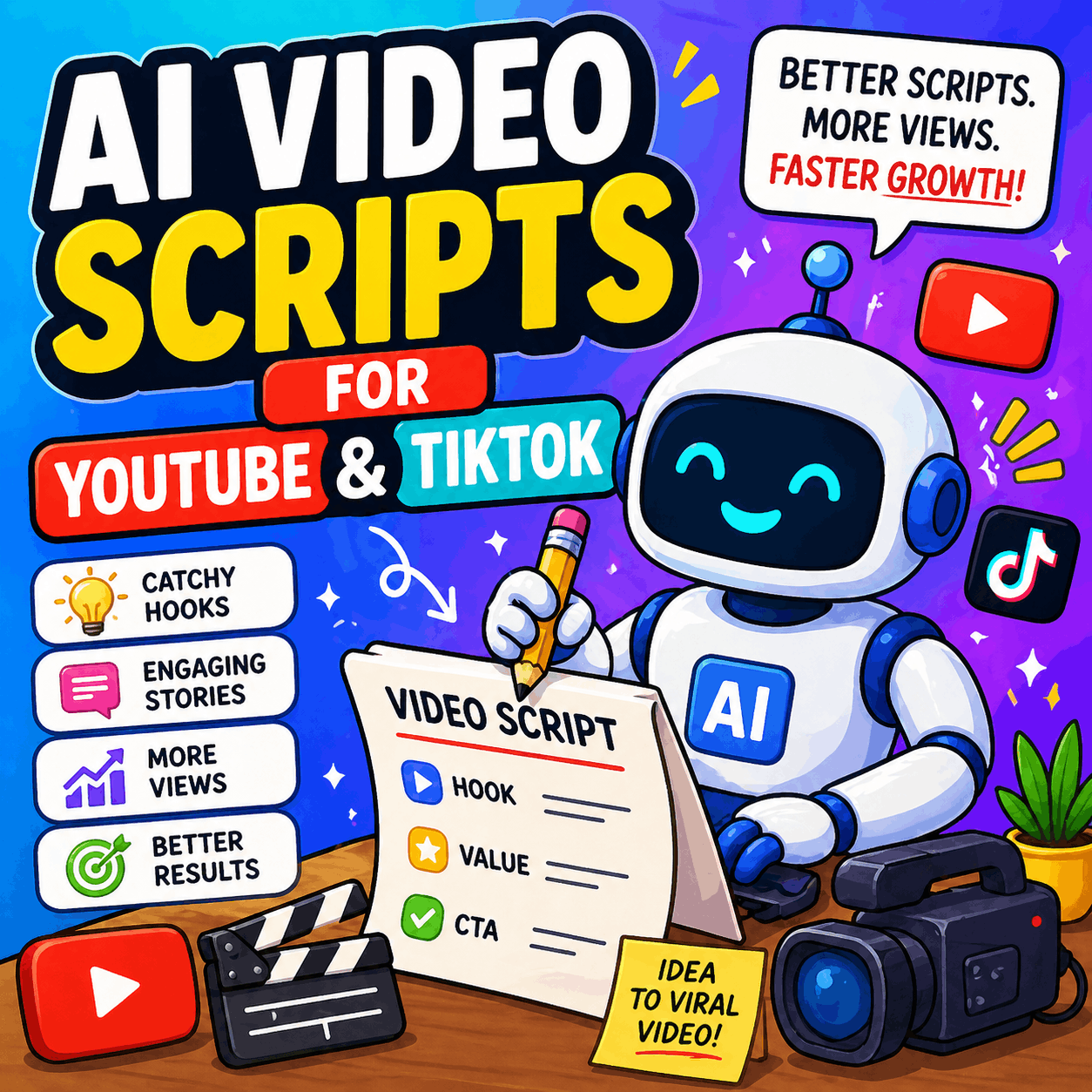
AI Video Scripts for YouTube & TikTok
Why AI Video Scripts Are Dominating Content Creation in 2026
Content creation used to require a team. A scriptwriter for research and narration, a voiceover artist, a video editor, a designer for thumbnails, and someone fluent in platform SEO. In 2026, AI tools handle every single one of those roles — and the numbers back this up.
The global AI-generated script market has reached $1.86 billion in 2026, growing at a 25.5% compound annual growth rate. Over 124 million people now use AI video platforms every month. And 91% of businesses currently use video as a marketing tool — making fast, quality scripting a genuine competitive advantage.
What changed isn’t just the tools. It’s the output quality. A few years ago, AI-generated scripts were easy to spot — generic hooks, hollow transitions, zero personality. Today, specialized AI script tools are trained on millions of viral videos and real viewer retention data. The gap between using the right AI tool versus a general chatbot is measurable: YouTube scripts from specialized AI tools achieve 52–68% viewer retention, while general-purpose AI outputs average just 28–42%.
If you’re a solo creator, a brand marketing team, or someone building a faceless channel, AI video scripting is no longer optional — it’s the most efficient entry point into content at scale.
YouTube vs TikTok: How AI Scripts Must Think Differently
This is where most creators (and most generic AI tools) get it wrong. YouTube and TikTok don’t just have different audiences — they have fundamentally different attention mechanics. A script that works beautifully on YouTube will feel slow and overproduced on TikTok. A TikTok script used for YouTube long-form will collapse within 60 seconds.
Here’s what the data shows about each platform in 2026:
TikTok Scripting Requirements
TikTok’s algorithm in 2026 weights watch-through rate at roughly 40–50% of its total ranking decision. Videos that hold viewers past the 70% mark get pushed to the For You page. That means your hook must land in 2 seconds maximum — not 5, not 3. Two.
- Optimal length: 15–60 seconds (roughly 50–200 words at natural speaking pace)
- Hook window: 0–2 seconds
- Energy level: Approximately 20% higher than normal conversational delivery
- Audio priority: TikTok is audio-first — trending sounds significantly boost reach
- Script structure: Hook → Punchy delivery → Hard CTA at 0:50–0:55 seconds (not at the very end)
- Tone: Raw, energetic, direct — polished production often underperforms authentic delivery
TikTok also rolled out follower-first testing in 2026, meaning new videos are shown primarily to your existing followers before being pushed wider. Your first wave of engagement matters more than ever, so your script must immediately resonate with people who already know your style.
YouTube Long-Form Scripting Requirements
YouTube rewards depth, structure, and sustained attention. A long-form video (typically 8–15 minutes for monetizable content) needs to function almost like a mini-documentary — with clear chapter breaks, emotional pacing, and regular pattern interrupts to re-engage viewers every 2–3 minutes.
- Hook window: First 15 seconds — open with a surprising fact, bold claim, or a curiosity gap
- Context phase: 30–60 seconds — give viewers enough background to care
- Core content: 5–12 minutes broken into 3–5 distinct sections, each delivering a specific insight
- Pattern interrupts: Every 2–3 minutes — change visual pace, introduce a new angle, or ask a rhetorical question
- CTA: Final 30 seconds — subscribe, comment, or direct to another video
- Script language: Should sound like spoken narration, NOT blog prose. Shorter sentences. Cleaner transitions.
YouTube Shorts Scripting Requirements
YouTube Shorts sits between these two worlds. Its 60-second maximum means you have slightly more room than TikTok (a 3–5 second hook is acceptable) but far less than long-form. Completion rate is still king, and the one-idea rule applies strictly — Shorts in the 50–60 second range can average up to 4.1M views when they stick to a single, clearly delivered concept.
Key Takeaway: Never cross-post an identical script from TikTok to YouTube Shorts or vice versa. Algorithms actively penalize reposted content with watermarks and the same formatting. Write once, customize twice.
The 3 Proven Script Structures AI Tools Use for Viral Content
AI script tools don’t generate scripts randomly. The best ones are trained on specific retention frameworks drawn from millions of high-performing videos. Here are the three structures that appear consistently across top-performing AI scripts:
1. Hook → Value → CTA
The simplest and most universal structure for short-form content. Used heavily for TikTok, Instagram Reels, and YouTube Shorts.
- Hook (0–3 seconds): A bold statement, surprising stat, or direct question that stops the scroll
- Value delivery: The core content — one idea, clearly explained, with fast pacing
- CTA: A specific action — “Follow for part 2,” “Comment X if you relate,” “Save this”
This structure works because it respects the viewer’s time and delivers on the hook’s implicit promise without detours.
2. Problem → Solution → Result
Common in educational, how-to, and product-focused scripts. Used across both YouTube long-form and short-form.
- Problem: Name a specific, relatable pain point immediately (“You’ve been writing scripts the wrong way”)
- Solution: Introduce the method, tool, or framework that fixes it
- Result: Show the outcome — ideally with a specific number or transformation (“Cut scripting time from 4 hours to 20 minutes”)
AI tools like Subscribr and Jasper build this into their templates because it maps naturally to viewer search intent. People search for solutions, not generic information.
3. Curiosity-Driven Storytelling (Open Loop Method)
Used most effectively in faceless YouTube channels covering true crime, history, psychology, and documentary-style content. This structure works by withholding the payoff.
- Open a loop: Introduce something intriguing that demands resolution (“In 1987, a mathematician discovered a pattern that changed everything about how we understand time”)
- Build the narrative: Add context, characters, and stakes layer by layer — each section answers a small question while opening a larger one
- Close the loop: Deliver the payoff at the end. This is what drives watch-through rates
The most critical rule for this structure: don’t front-load information. AI tools like ChatGPT often dump all information upfront, which kills suspense immediately. Specialized video scripting tools are trained to withhold strategically.
The Hook Problem: What the First 3 Seconds Actually Decide
Platform research consistently shows that 71% of viewers decide within the first 3 seconds whether to continue watching. This isn’t a creative guideline — it’s the core mechanic of every short-form algorithm. The hook isn’t just the opening line of your script. It’s the entire business case for your video.
Here are the five hook categories that generate the highest scroll-stops in 2026, based on cross-platform performance data:
1. The Specific Stat Hook Example: “Your lungs can hold 6 liters of air. You’re using 0.5.” Why it works: specificity creates an instant knowledge gap the viewer needs to close.
2. The Contrarian Hook Example: “Everything you know about YouTube growth is wrong.” Why it works: challenges a belief the viewer holds, triggering defensive curiosity.
3. The Pain Point Hook Example: “Stop doing [common mistake] right now.” Why it works: speaks directly to a struggle the viewer recognizes, triggering self-identification.
4. The Pattern Interrupt Example: An unexpected visual, sound, or cut that breaks the viewer’s scroll reflex before the first word is spoken. Why it works: disrupts the autopilot state that causes scrolling.
5. The Direct Question Example: “Did you know most creators are leaving 40% of their reach on the table?” Why it works: engages the viewer immediately by requiring a mental response.
AI tools excel at generating multiple hook variations from a single topic. The standard practice among professional creators in 2026 is to generate 8–10 hook versions for the same video, then A/B test them using different posting times and track which hook drives the highest 70% completion rate.
Best AI Script Generator Tools for YouTube (Long-Form & Faceless)
Subscribr
Subscribr is one of the most data-driven YouTube scripting tools available in 2026. It connects to your YouTube channel, learns your niche and style, and scans thousands of competitor channels to find videos generating 2x–10x more views than normal. It extracts the psychological hook, title structure, and thumbnail concept from those outliers — then rewrites them for your specific niche.
Best for: Faceless channels, tutorials, documentaries, story-based content
Standout feature: Retention-focused templates built on frameworks like WHY-WHAT-HOW and OBSERVATION-INSIGHT-EVIDENCE, with dedicated tools for open loops and pattern interrupt timing
Pricing: From $7 (trial) — paid plans scale for volume
Jasper AI
Jasper’s YouTube Script Writer is purpose-built for video, not just generic text. It produces scripts with proper YouTube formatting: pacing, retention cues, and natural spoken language rather than blog-style prose.
Best for: Brands, marketing teams, and established creators who need consistent script quality
Standout feature: Tone customization and brand voice matching
External link: Jasper YouTube Script Writer
Junia AI
Junia AI’s YouTube script generator covers the full range of content types: tutorials, faceless videos, commentary, product reviews, storytime, educational explainers, and lists. You can regenerate specific sections (just the hook, just the outro) without rewriting the entire script, and export directly to teleprompter software.
Best for: Creators who need format flexibility and individual section editing
Standout feature: Section-by-section regeneration; hook and outro can be refined independently
ChatGPT / Claude (General-Purpose LLMs)
For YouTube scripting, general-purpose AI models like ChatGPT and Claude are the most flexible option — you can specify tone, structure, word count, and target audience in ways that template-based tools can’t match. You can brainstorm 20 video topics, outline a script structure, and generate full narration in a single conversation.
The trade-off is that this is a manual workflow with no platform integration, and the output tends to be generic without specialized prompting. The best practice: feed the AI examples of high-performing scripts in your niche as reference material before asking it to generate.
Pricing: Free tier available. Paid plans at $20/month each.
Looking to take your video content further? Check out our guide on Top AI Video Editing Tools for Beginners to combine AI scripts with the right editing workflow.
Best AI Script Generator Tools for TikTok & Short-Form
Revid.ai
Revid.ai is built specifically for TikTok quick ideation. You choose a script style, set your recording time, describe your topic, and generate a ready-to-record TikTok script in one click. You can also paste a link — a PDF, blog post, TikTok, or YouTube video — as your source material.
Best for: Creators and marketers who want fast, style-based TikTok scripts from a topic or source link
Standout feature: Link-to-script conversion for rapid content repurposing
Memories.ai TikTok Script Generator
What makes Memories.ai stand out is that it doesn’t just write scripts — it analyzes what’s currently going viral on TikTok before generating anything. The platform looks at trending content in your niche, breaks down successful videos into hook design, story flow, and CTA placement, then creates ready-to-use scripts based on those patterns.
Best for: Creators who want to learn from what’s already working, not just generate from scratch
Standout feature: Viral video storyboard breakdown combined with script generation
Pricing: Free ($0/month with 100 credits); Plus plan from $15/month billed annually
Videotok
Videotok’s Script Generator is a free, web-based tool designed for creators who need scripts fast — no signup required. Enter a short description of your video topic and it generates a concise script for TikTok, Instagram Reels, and YouTube Shorts, with attention-grabbing hooks built in. It also integrates with Videotok’s broader video production tools for converting scripts to faceless videos.
Best for: Quick scripting without account requirements
Standout feature: Zero-friction — no login, no cost, immediate script output
Restream AI TikTok Script Generator
Restream’s free TikTok script generator is a mood-based scripting tool. You enter a topic, choose a vibe (funny, quirky, serious, informative), and receive a TikTok-ready script in seconds. No ads, no account required, unlimited generations.
Best for: Creators exploring different tones for their TikTok presence
Standout feature: Mood selector that adapts script personality, not just topic
Opus Clip (Repurposing Long-Form → Short-Form)
Opus Clip doesn’t write scripts from scratch — it extracts them from existing content. Upload a long-form YouTube video and Opus Clip delivers multiple ready-to-post short clips for TikTok and Reels, complete with captions and a virality score that predicts which clips are most likely to perform.
Best for: Creators who already have long-form content and want to multiply it into short-form without additional scripting
Standout feature: Virality score based on engagement pattern analysis
CapCut (Native TikTok Integration)
CapCut is ByteDance’s own video editor, which gives it a structural advantage no third-party tool can replicate: direct TikTok integration. In 2026, CapCut’s AI has expanded significantly — its Doubao LLM now powers script writing and creative direction, while the Seedance model handles video generation. The workflow starts with a conversational prompt; CapCut’s AI asks clarifying questions, builds a creative brief, and produces a complete video with voiceover, captions, and transitions — often in under five minutes.
Best for: Creators who want to go from script idea to finished TikTok video without switching apps
Standout feature: End-to-end TikTok production in a single tool with platform-native posting
Real-World Use Cases: Creators, Faceless Channels & Brands
Faceless YouTube Channels
Some of the biggest channels on YouTube have never shown a face on camera. Bright Side has 44 million subscribers. Kurzgesagt has 23 million. In 2026, AI handles virtually the entire production pipeline: research, scripting, voiceover, editing, thumbnails. What previously required a full production team now takes one person approximately two hours per video.
The key insight from studying these channels: AI produces the first draft, but human judgment handles structure and storytelling. The most effective faceless scripts use AI to generate the framework and research-heavy sections, then human editors tighten the pacing, sharpen the hook, and add the personality layer that makes a channel distinctive.
Critical warning: Faceless channels using purely AI-generated imagery see 25–35% lower average view duration than channels that blend stock footage with authentic B-roll. AI scripts are strong; AI visuals still need human curation.
Brand Marketing Teams
For brands, AI script generators solve two specific problems: consistency and speed. Marketing teams can generate multiple script variations for the same campaign, A/B test different hooks systematically, and maintain brand voice across dozens of videos without extensive writer briefings.
A common professional workflow in 2026: generate 10 hook variations in Week 1, test them with the same core content; in Week 2, take the winning hook and test 5 different CTAs; in Week 3, test video lengths (15s, 30s, 60s). This systematic approach, powered by AI scripting speed, is how brands identify high-performing creative formulas at scale.
Individual Creators on TikTok
For individual TikTok creators, the biggest time-saving application isn’t generating full scripts — it’s generating hook variations. A creator who would normally spend 45 minutes crafting the perfect opening line can now generate 10 options in under a minute, each with a different psychological trigger (curiosity, pain point, contrarian claim, specific stat), and choose the strongest one for their audience.
The Honest Limitations of AI-Generated Video Scripts
No balanced guide should skip this section, and most do. Here’s what AI scripts consistently get wrong in 2026:
1. Generic Output Without Specialization General-purpose AI models like ChatGPT produce scripts that the r/NewTubers community (644,000+ creators) describes as “instantly recognizable as AI” — formulaic hooks, predictable structures, and zero personality. When every creator uses the same tool with similar prompts, every script sounds identical. The solution is platform-specific and niche-specific prompting, or purpose-built video scripting tools.
2. No Compounding Methodology Standard AI prompting generates one script at a time, with the AI starting fresh each session. There’s no memory of what worked in your previous 20 scripts, what your audience responded to, or what your channel’s specific retention patterns look like. Specialized tools like Subscribr address this by connecting to your channel data.
3. Front-Loading Information (The Storytelling Failure) General AI will write: “Here’s a story about a haunted house. The house was built in 1920 and a murder happened there in 1935…” This is telling, not storytelling. Effective scripts reveal information gradually, building suspense and curiosity. AI tools not trained on video retention data consistently fail at this.
4. Misreading Spoken vs. Written Language Blog-style prose pasted into text-to-speech sounds robotic and flat. AI tools that are trained on text content (not spoken narration) produce scripts that read well but sound unnatural when recorded. Short sentences, conversational pauses, and natural transitions must often be added manually.
5. Platform Format Confusion A general-purpose AI can’t simultaneously excel at a 60-second TikTok ad script, a 20-minute YouTube deep dive, and a film screenplay. Yet that’s what most creators ask it to do. The output quality drops significantly when the tool doesn’t understand platform-specific mechanics.
2026 Trends Shaping AI Video Scripting
Short-Form Dominance Is Absolute — But Depth Still Wins on YouTube
TikTok now holds approximately 40% market share with over 2 billion monthly users. YouTube Shorts and Instagram Reels each command roughly 20%. But the insight that matters for scriptwriters: short-form has stabilized. Virality in 2026 isn’t just about being short — it’s about being complete within the short format. The 15–30 second sweet spot for TikTok delivers higher completion rates than 60-second videos, even though platforms allow longer content.
On YouTube, the opposite is true: depth is being rewarded. Long-form content in educational and documentary niches continues to drive the highest subscriber conversion and RPM (revenue per 1,000 views).
Data-Driven Hook Testing Has Replaced Creative Guessing
The most effective creators in 2026 no longer rely on intuition for their hooks. They use AI to generate 8–10 hook variations, post them in rapid succession, and use platform analytics to identify which hook pattern drives the highest 70%+ completion rate for their specific audience. This is a methodology shift — AI scripting is now part of a systematic testing loop, not a one-shot content generation tool.
AI + Virality Scoring
Tools like Opus Clip have introduced virality scores — AI-generated predictions of which clips or scripts are most likely to perform based on engagement patterns in similar content. Memories.ai takes this further by analyzing current TikTok trends before generating any script, essentially making the trend data the starting point rather than an afterthought.
Personalized Scripts and Voice Matching
The frontier of AI scripting in 2026 is persistent voice memory. Tools like Subscribr connect to your channel to learn your niche and style. Platforms like Jenova offer cross-session memory that learns your voice over time. The goal: AI-generated scripts that sound like you wrote them, not like a template.
AI Content Labeling Requirements
This is a 2026 reality that every creator needs to understand. TikTok now auto-detects unlabeled AI content and removes it. If you use AI-generated visuals, voiceovers, or scripts without proper disclosure, your content is at algorithmic risk. Every tool worth using in 2026 should ensure outputs meet platform AI content labeling requirements.
Authentic Raw Content Outperforming Polished AI Production
Here’s the counterintuitive trend: even as AI production quality improves dramatically, raw, authentic content is outperforming polished AI-generated videos on short-form platforms. Research shows authentic content performs 60% better than overly produced videos, with over 50% of engagement coming from everyday creators rather than brands. The takeaway for AI script users: use AI to generate structure and speed up drafting, but deliver the script with genuine human energy — not an AI voice reading AI text.
How to Combine AI + Your Own Voice for Maximum Engagement
The creators seeing the strongest results in 2026 are not using AI to replace their voice — they’re using it to remove the friction that previously prevented them from showing up consistently. Here’s the workflow that combines speed with authenticity:
Step 1: Research Phase (AI-Assisted) Use tools like Subscribr or Memories.ai to identify what’s currently outperforming in your niche. Feed that data to your script tool as reference material, not just a topic.
Step 2: Structure Generation (AI Draft) Generate a full script draft with your chosen tool. Ask for 3 hook variations before locking in the opening line.
Step 3: Voice Layer (Human Edit) Read the script aloud before filming. Anything that sounds like a blog post, rewrite it. Your goal: every line should sound like something you’d actually say in a conversation, not something you’d type in an email.
Step 4: Platform Optimization (Tool-Specific) For TikTok: confirm your hook lands before the 2-second mark. For YouTube long-form: ensure a pattern interrupt exists every 2–3 minutes. For Shorts: verify the entire script serves one idea.
Step 5: CTA Engineering Never leave the CTA to chance. Specify it explicitly in your AI prompt: “Include a CTA at the end asking viewers to [specific action].” The most effective short-form CTAs in 2026 are comment-driven (“Comment ‘YES’ if you want part 2”) because comments trigger the algorithm more than passive likes.
FAQs
Can AI video scripts hurt my channel’s SEO or ranking?
No — platforms rank content based on engagement signals (watch time, completion rate, shares, saves), not based on whether a script was AI-generated. What matters is whether the script produces a video that viewers actually watch through. A well-crafted AI script that drives high completion rates will outperform a poorly written human script every time.
How long should an AI-generated TikTok script be?
For optimal engagement, TikTok scripts should be 15–60 seconds when spoken aloud — roughly 50–200 words depending on your speaking pace. Scripts targeting virality should aim for the 15–30 second range, where completion rates are highest.
Is there a free AI script generator for YouTube and TikTok?
Yes. Restream offers a free, unlimited TikTok script generator with no signup required. Videotok’s script generator is also free with no account needed. For YouTube, Junia AI and Kapwing both offer free tiers with script generation. General-purpose tools like ChatGPT and Claude have free tiers as well, though they require more specific prompting for video-format output.
What’s the biggest mistake creators make with AI video scripts?
Using AI output as a final product without editing. The most effective creators treat AI scripts as a first draft that needs a voice layer — they tighten pacing, rewrite blog-style sentences into spoken language, and inject their own personality before recording. Raw AI output without this editing step consistently underperforms.
Do AI scripts work for faceless YouTube channels?
Yes — faceless channels are one of the strongest use cases for AI scripting. Tools like Subscribr, Jasper, and FacelessOS are specifically optimized for narration-heavy content. The key limitation to watch: don’t rely entirely on AI-generated visuals alongside AI scripts. Blending AI narration with curated stock footage or authentic B-roll significantly improves average view duration.
Final Thoughts
AI video scripts for YouTube & TikTok are not a replacement for creative thinking — they’re an accelerant for it. The creators and brands winning in 2026 are the ones using AI to eliminate the friction of getting started: research, structure, hook drafting, and format optimization. They’re not using AI to skip the human step that actually converts viewers into loyal audiences.
The tool you choose matters. General-purpose chatbots produce generic output. Platform-specific tools trained on real retention data produce scripts that hold viewers. But the most important variable remains the voice and judgment of the person behind the content.
Start with one tool. Generate 5 scripts. Publish them. Look at your completion rate data. Iterate. That loop — not any single tool — is what actually builds a channel.
Want to maximize your video content workflow even further? Read our in-depth breakdown of Top AI Video Editing Tools for Beginners to pair your AI scripts with the right post-production setup.