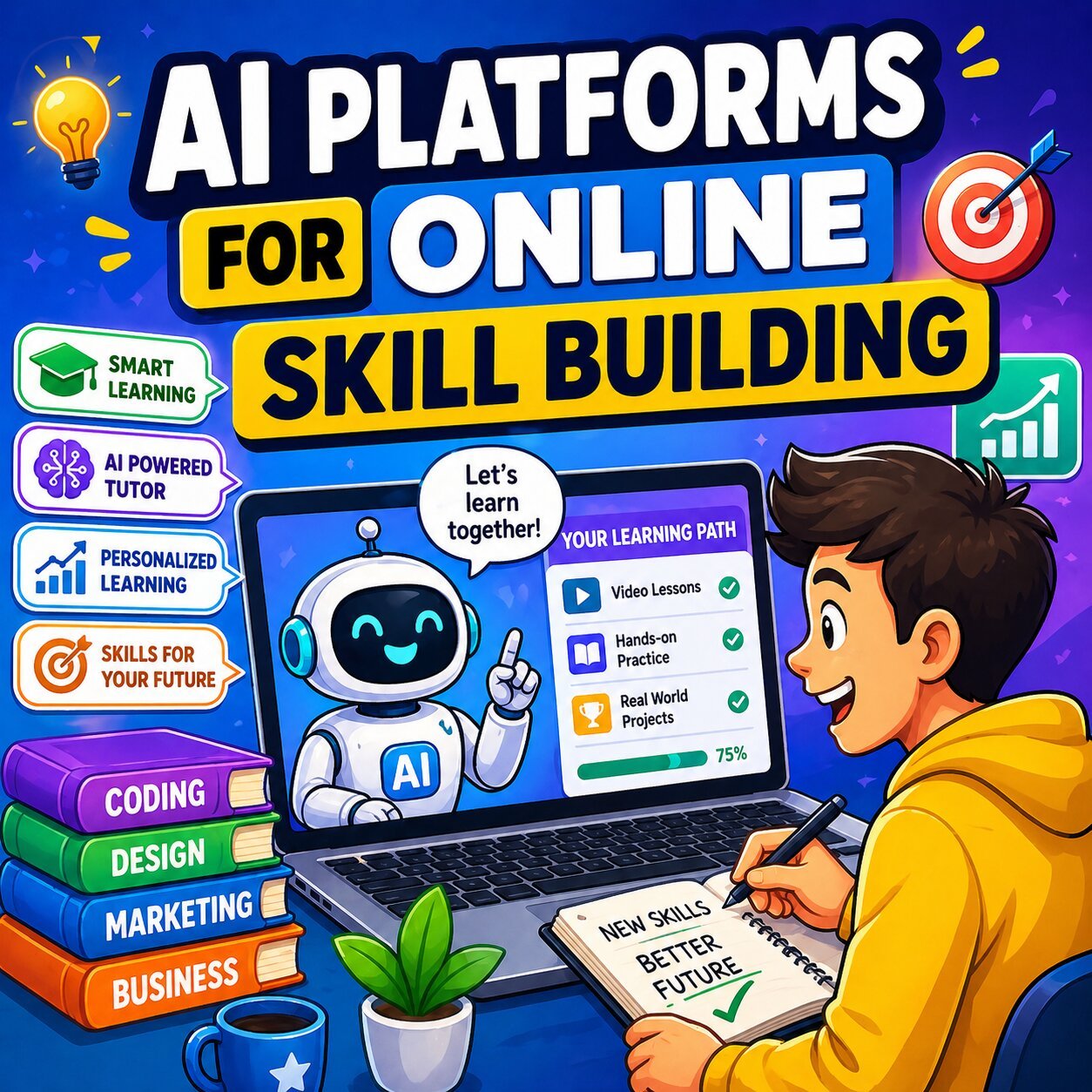
Best AI Platforms for Online Skill Building in 2026
There’s a quiet but decisive split happening in the world of online learning. On one side are learners still grinding through static video courses, skipping modules, and abandoning programs halfway through. On the other hand, learners are using AI platforms for online skill building — getting real-time feedback, personalized learning paths, and skill gap detection that adapts as they grow. The gap in outcomes between these two groups is widening fast.
In 2026, the AI education market is no longer experimental. It has crossed $7.57 billion globally, with 86% of education organizations now using generative AI — the highest adoption rate of any industry. Whether you’re a student trying to close a knowledge gap, a freelancer adding to your portfolio, or a professional future-proofing a career, picking the right platform has never mattered more. This guide breaks down exactly what’s worth your time and money in 2026 — no fluff, no affiliate-driven rankings.
Why AI Is Changing How We Learn Online
Before diving into specific platforms, it’s worth understanding what separates AI-powered learning from the traditional MOOC model you’ve probably already tried and abandoned.
Traditional platforms — think early Coursera or Udemy — gave everyone the same content in the same order at the same pace. You either kept up or you didn’t. AI-powered platforms do something fundamentally different: they adapt to you in real time. They detect where you’re struggling, skip what you already know, surface relevant content at the right moment, and provide feedback the way a human tutor would — except they’re available at 2 a.m. and they never lose patience.
Here’s what the data says about the difference:
- Adaptive learning systems show a 42% improvement in learning outcomes versus static content, based on Carnegie Learning’s data from over one million students
- AI-tutored courses achieve completion rates of 40–50%, compared to the industry average of just 15% for self-paced programs
- Microlearning formats powered by AI hit completion rates as high as 80% — and are produced 300% faster at 50% of the cost of traditional courseware
- According to the OECD’s Digital Education Outlook 2026, generative AI now engages learners through flexible, adaptive Socratic dialogue — guiding reasoning rather than just delivering answers
The shift isn’t just incremental. It’s a different category of product.
What to Look for in an AI Learning Platform
Not every platform that mentions “AI” in its marketing actually uses it in a way that improves your learning. Here’s a practical checklist before you commit:
- Adaptive recommendations — does the platform adjust based on your actual behavior, or just suggest popular courses?
- Personalized learning paths — are paths built around your skill level and goals, not just job title?
- Skill tracking and analytics — can you see where your gaps are and how you’re closing them?
- Certifications with career alignment — are credentials recognized by employers, or just a PDF for your files?
- Real-time feedback loops — do you get corrective feedback during practice, or only after submitting an assignment?
If a platform can’t clearly answer “yes” to at least three of these, it’s a content library with a thin AI wrapper — not a genuine AI learning platform.
Top AI Platforms for Online Skill Building by Category
One of the biggest mistakes people make is choosing a platform based on brand recognition rather than fit. The right platform depends entirely on what skill you’re building and where you’re starting from. Here’s a research-backed breakdown by category.
Best AI Platforms for Coding and Tech Skills
DataCamp
DataCamp consistently ranks as the top data-focused learning platform in 2026, earning an overall score of 9.8/10 in multiple independent comparisons. Its AI checks your code in real time, flags errors, explains why something broke, and suggests the fix — all before you move to the next step. The platform’s structured paths through Python, SQL, machine learning, and data engineering are tightly sequenced, not loosely bundled.
Best for: Data analysts, aspiring data scientists, and developers moving into ML
Pricing: ~$25/month (frequently discounted for annual plans)
Weakness: Narrow focus — not ideal if your goals go beyond data and tech
Coursera (Professional Certificates)
Coursera’s scale is difficult to overstate — 168.2 million registered learners, 12,000+ courses, and partnerships with Google, IBM, Meta, Stanford, and Yale. The platform’s AI Coach reviews written assignments and provides personalized feedback 24/7, functioning like a teaching assistant that’s always available.
The credential value here is real. Google, IBM, and Meta Professional Certificates on Coursera are increasingly recognized by hiring managers as a legitimate signal of job-readiness — particularly for roles in data analytics, UX design, IT support, and cybersecurity.
Best for: Career changers seeking employer-recognized credentials
Pricing: Free to audit; certificates from $39–$79/month; Coursera Plus ~$59/month
Weakness: Rigid course structure; some paths feel slow for experienced learners
Codecademy and Mimo
For beginners learning to code, Codecademy and Mimo offer AI-guided hints, browser-based coding environments, and project-based progression that builds confidence before complexity. Neither replaces DataCamp for depth, but both are excellent entry ramps.
Free Certifications Worth Pursuing: OpenAI Academy and Google AI Skills
Two genuinely underrated options for professionals in 2026:
OpenAI Academy launched AI fluency certifications in early 2026, covering prompt engineering through AI-enabled workflows. They’re free, they carry the OpenAI brand, and they’re positioned to become resume signals in the same way AWS certifications became standard for cloud roles.
Google AI Professional Certificate includes 20+ hands-on activities and has reported that 85% of learners say the program contributed directly to their goal of gaining expertise with generative AI tools. Free or near-free depending on the track.
If you’re building a learning stack and want a cost-effective credential that signals fluency to employers, these two are the smartest additions you’re probably not making yet.
Best AI Platforms for Language Learning
Duolingo Max
Duolingo’s transformation into a fully AI-first platform is one of the most well-documented case studies in EdTech. In 2025, CEO Luis von Ahn declared the company “AI-first,” restructuring content creation around ML pipelines and integrating GPT-4 across its flagship features.
Duolingo Max — the platform’s premium tier at $168/year — now includes:
- Roleplay: AI-powered real-world conversation scenarios (ordering food, job interviews, travel) with no two conversations exactly alike
- Video Call with Lily: voice conversations with an AI character that provides post-call transcripts and targeted improvement notes
- Explain My Answer: now free for all users as of January 2026 — previously a paid feature
The platform passed 50 million daily active users in Q3 2025 and reported 41% year-over-year revenue growth. In September 2025, Duolingo integrated its scoring system directly with LinkedIn profiles — one of the first language learning platforms to bridge informal skill practice with professional credentialing.
Best for: Language learners who want gamified, consistent daily practice with genuine speaking feedback
Pricing: Free tier strong; Super Duolingo at $84/year; Duolingo Max at $168/year
Weakness: Short AI conversations; learners who need deep conversational immersion may need a supplement
Best AI Platforms for Business, Marketing, and Soft Skills
LinkedIn Learning
LinkedIn Learning’s core advantage isn’t the content — it’s the data underneath it. The platform recommends courses based on your actual LinkedIn profile, the jobs you’re looking at, and the skills showing up in listings for your target roles. Complete a course and the certificate appears directly on your profile, visible to recruiters passively browsing your background.
For business and soft skills — communication, management, negotiation, productivity — LinkedIn Learning is the most career-aligned option available. Pair it with the best AI analytics tools for tracking your own growth and you’ll have a measurable picture of skill development over time.
Best for: Professionals actively job searching or seeking internal promotion
Pricing: ~$39.99/month; often included with LinkedIn Premium
HubSpot Academy
HubSpot Academy deserves more credit than it gets. It’s completely free, consistently updated, and its certifications in digital marketing, content strategy, SEO, and CRM are recognized across the industry — particularly in marketing, sales, and SaaS roles. For freelancers building a client-facing skillset, it’s one of the highest ROI free resources available.
Udemy Business
Udemy’s library of 210,000+ courses is unmatched for breadth. The AI-powered search and recommendation engine has improved substantially — it now surfaces contextually relevant courses based on your learning history, not just keyword matching. Individual courses cost $10–$15 during frequent sales, and you keep lifetime access to anything you purchase.
Weakness: No adaptive learning path; completion rates suffer because there’s no accountability structure built in.
If you’re learning business communication or content skills and creating client deliverables, pairing Udemy courses with AI email assistants that save time on outreach creates a practical loop between learning and applying.
Best AI Platforms for Creative Skills and Content Creation
Skillshare
Skillshare’s unlimited-access model makes it the most cost-effective platform for creative skill stacking. Design, illustration, video editing, writing, branding — the library is broad and the format is practical. Courses are shorter and more project-oriented than Coursera’s academic style, which suits learners who want to build a portfolio over accumulating a credential.
The 2026 online course market is projected to reach $400 billion. If you’re building content creation skills to participate in that market — not just consume from it — pairing Skillshare with tools that accelerate production matters. If you’re producing video content alongside your learning, check out how AI video scripts can dramatically cut production time for YouTube and TikTok, or how AI video editing tools make the post-production process accessible for beginners.
For freelancers managing client communication while building new skills, an AI email reply generator can free up hours each week you’d otherwise spend on routine responses.
Best Enterprise AI Learning Platforms for Teams
If you’re an L&D manager or business owner evaluating platforms for a team, the individual-learner options above don’t scale well. This category operates differently — deeper AI infrastructure, LMS integrations, compliance tracking, and skills management at an organizational level.
CYPHER Learning
CYPHER Learning is widely cited as the most AI-native LMS heading into 2026. Its CYPHER Agent can build a complete course — including gamification elements, assessments, and adaptive paths — from a PDF or video in minutes. No instructional design experience required. The platform continuously monitors competency data and adjusts recommendations as learners progress.
Best for: Organizations that want to scale training content creation internally without dedicated L&D staff
Docebo
Docebo’s AI LMS includes virtual coaching, scenario-based skill simulators, and an AI content creator that allows subject matter experts to build training without involving instructional designers. Engineers can build training for engineers. Sales teams can build their own use-case libraries. It’s a meaningful democratization of content creation inside large organizations.
Best for: Enterprises with diverse training needs across departments and regions
Degreed
Degreed maps employee skills and uses AI to curate learning paths that close specific, measurable gaps. Crucially, it connects learning to hiring decisions, performance reviews, and internal mobility — not just course completion. It’s the platform that most directly ties skill development to business outcomes.
According to the 2026 LinkedIn Talent Report, 86% of professionals are stuck in a skills gap while 14% are accelerating past them. Degreed is built specifically to close that gap at scale.
Best for: Mid-to-large enterprises managing talent development across departments
Go1
Go1 offers 2,500+ AI-specific courses with role-based learning pathways and AI-recommended learning frameworks. 82% of L&D leaders report already using AI in their learning programs — Go1 is designed for teams that don’t want to build curriculum from scratch.
Six Emerging Trends Reshaping AI-Powered Skill Building
The platforms above represent where the market is today. What follows is where it’s going — and why the gap between early adopters and late movers will keep widening.
1. Agentic AI Tutors: The End of Static Modules
The most significant shift in AI education right now is the move from reactive chatbots to proactive AI agents. Agentic AI tutors don’t wait for you to ask a question — they monitor your performance, detect confusion before you’re aware of it, and intervene with targeted support in real time.
Khan Academy’s Khanmigo (powered by GPT-4) demonstrated this at scale. A six-month pilot with 14,000 students showed measurable improvements in both engagement and comprehension. Khanmigo asks guiding questions instead of giving answers — a deliberate pedagogical choice to build understanding rather than dependency. At $4/month for learners (free for teachers), it’s the most accessible AI tutor available. The OECD’s Digital Education Outlook 2026 specifically calls out this Socratic approach as the most effective AI-driven learning model identified in current research.
Risk worth acknowledging: The same OECD report warns against the “illusion of learning” — where learners feel productive because AI is doing the heavy lifting, without developing genuine mastery or critical thinking. The best platforms are designed to avoid this; the worst ones quietly enable it.
2. Microlearning 2.0: AI-Adaptive, Context-Aware Content
Microlearning isn’t new, but AI-adaptive microlearning is different in a meaningful way. Traditional microlearning gives everyone the same bite-sized content. AI-adaptive microlearning gives each learner different content based on what they actually need at that moment — and delivers it inside the tools they already use, not in a separate LMS they have to remember to visit.
Platforms like Go1 and Degreed are pioneering “learning in the flow of work” — surfacing relevant microlearning content inside Slack, CRMs, or browsers at the exact moment a skill gap appears. For busy professionals who can’t carve out dedicated learning hours, this model is a material improvement over any scheduled course.
3. Skill Intelligence: AI That Knows What You Don’t Know You Don’t Know
Skill intelligence systems don’t just track course completion — they continuously model each learner’s competency profile, detect gaps they haven’t noticed, and recommend targeted content to close them before those gaps become problems.
This goes beyond a progress bar. Platforms like Degreed and Cornerstone Galaxy maintain a living map of what each employee can do, connected directly to the skills their role requires and the trajectory their career could take. For organizations managing fast-changing skill requirements, this is a qualitatively different capability than anything available three years ago.
4. Generative AI for Course Creation at Scale
The bottleneck in organizational training used to be content creation. Building a quality course took weeks, required instructional design expertise, and became outdated quickly. Generative AI has broken this bottleneck entirely.
Tools like CYPHER Agent, Docebo’s AI content creator, and TalentLMS’s TalentCraft can turn a document, a presentation, or even a rough set of notes into a structured course — complete with quizzes, summaries, and adaptive paths — in minutes.
The risk here is real: AI-generated content can contain factual errors, pedagogical inconsistencies, and hallucinated specifics. Leading platforms are addressing this with multi-layer validation: automated fact-checking against verified knowledge bases, rule-based pedagogical linting, and human SME review of a percentage of generated content. If a platform you’re evaluating for team training can’t explain how it handles this, treat it as a red flag.
5. Credentials That Actually Get You Jobs
The credential landscape is maturing. Coursera certificates from Google, IBM, and Meta are now commonly referenced in job postings as explicit requirements or preferences. Duolingo Scores can appear on LinkedIn profiles. OpenAI Academy certifications are positioned to become the AI-fluency standard across industries.
Micro-credentials are also gaining acceptance alongside traditional degrees — particularly in tech, marketing, and data roles where demonstrated skill matters more than institutional pedigree. The hybrid model (cohort-based courses with AI-powered support) is proving to be the sweet spot: 85–95% completion rates versus 15% for purely self-paced, without the scheduling constraints of fully live delivery.
6. Immersive AI Training: Simulation-Based Skill Practice
For skills where practice matters more than knowledge — sales conversations, leadership scenarios, patient communication, customer service — immersive AI simulation platforms are changing what “training” means.
Virti uses AI virtual humans to run realistic role-play simulations across healthcare, retail, and corporate training. A single platform can train a surgeon’s bedside manner, a store manager’s conflict resolution skills, and a sales rep’s objection handling — all using adaptive AI scenarios that adjust to the learner’s responses.
Second Nature focuses on AI sales coaching, generating realistic buyer personas and objection patterns. VirtualSpeech gives feedback on speaking pace, filler words, and eye contact during VR presentations. Mursion uses a hybrid of AI and live human simulation specialists for high-stakes interpersonal scenarios.
The data from these platforms is consistent: practice in high-fidelity simulations translates to measurably better performance in real-world situations, faster than traditional observation or shadowing.
Gaps and Limitations: What Current AI Learning Platforms Still Miss
No honest review of AI learning platforms should skip this section. For all the genuine progress, several problems remain unsolved.
The illusion of learning. When AI makes learning feel smooth and frictionless, it can create the impression of mastery without the underlying consolidation of knowledge. The OECD specifically flagged this — learners who rely heavily on AI explanations often perform worse on delayed recall tests than those who struggled through content more independently.
English-first bias. Most leading AI learning platforms are built primarily for English-speaking markets. While CYPHER Learning, Docebo, and Brightspace offer multilingual delivery, the depth of adaptive AI features often drops significantly in non-English languages.
Credential recognition gaps. Outside of Coursera, LinkedIn Learning, and Google certificates, employer recognition of AI platform credentials remains inconsistent. A certificate from a smaller LMS carries little weight without a portfolio to back it.
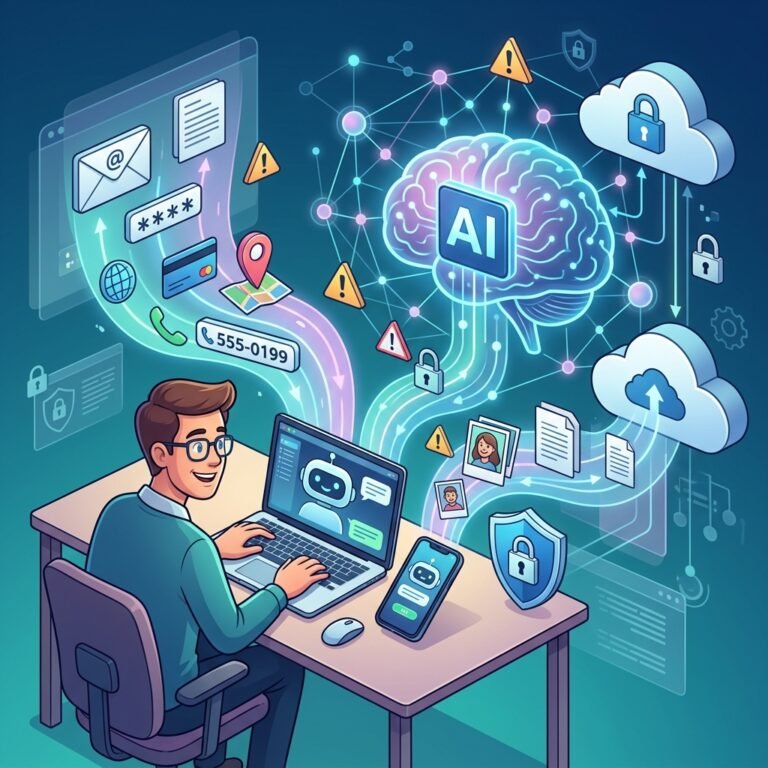
Privacy and behavioral tracking. The adaptive AI features that make these platforms valuable require deep behavioral data — how long you pause on a concept, how many attempts you take, which content you skip. The data practices of many platforms in this category deserve more scrutiny than they typically get.
The gap for advanced learners. Most AI learning platforms are optimized for beginner-to-intermediate skill development. Truly advanced learners — researchers, senior engineers, specialized practitioners — often find that AI-recommended content plateaus below where they actually are.
AI Platform Comparison: Quick-Reference Guide
| Platform | Best For | Key AI Feature | Pricing | Credential |
|---|---|---|---|---|
| Coursera | Career changers, credentials | AI Coach for assignment feedback | Free audit / $39–79/mo | Employer-recognized |
| DataCamp | Data & tech skills | Real-time code feedback | ~$25/mo | Industry-recognized |
| LinkedIn Learning | Professional growth | Profile-based recommendations | ~$40/mo | LinkedIn profile badge |
| Duolingo Max | Language learning | GPT-4 Roleplay + Video Call | $168/yr | LinkedIn integration |
| Khan Academy (Khanmigo) | Students, foundational | AI Socratic tutor | Free / $4/mo | N/A |
| Udemy | Topic diversity | AI search + recommendations | $10–15/course | Completion certificate |
| Skillshare | Creative skills | AI content discovery | ~$168/yr | N/A |
| HubSpot Academy | Marketing / CRM | Structured learning paths | Free | Industry-recognized |
| CYPHER Learning | Enterprise teams | CYPHER Agent course builder | Custom pricing | Custom |
| Docebo | Large enterprises | AI coaching + simulators | Custom pricing | Custom |
| Degreed | Skill intelligence | Competency mapping + gap close | Custom pricing | Integrated with HR |
| Go1 | L&D teams | 2,500+ AI courses + pathways | Custom pricing | Varies |
How to Choose the Right AI Learning Platform for Your Situation
There’s no universal best platform. There’s only the best platform for what you’re trying to do, given your budget, timeline, and the actual skill you’re building.
Here’s a practical decision framework:
Start with your goal, not the platform’s features:
- Job-ready credential in 3–6 months → Coursera Professional Certificates
- Data/coding skills with real feedback → DataCamp
- Language for travel or work → Duolingo Max
- Foundational knowledge at zero cost → Khan Academy + Google AI Skills + HubSpot Academy
- Creative/freelance portfolio building → Skillshare + Udemy
- Team training and skills management → CYPHER Learning, Docebo, or Degreed depending on scale
Budget anchors for 2026:
- $0: Khan Academy, freeCodeCamp, Google AI Skills, HubSpot Academy, MIT OpenCourseWare
- $10–25/month: DataCamp, Codecademy, Udemy (per course)
- $39–79/month: Coursera Plus, LinkedIn Learning
- $84–168/year: Skillshare, Duolingo Max, Super Duolingo
Free vs. Paid: When the Upgrade Is Worth It
Free tiers are genuinely excellent for foundational learning. Don’t pay for a platform before you’ve exhausted what the free version gives you. That said, three scenarios consistently justify upgrading:
- You need a credential. Auditing courses is free; certificates cost money, and the credential is often the whole point.
- You need adaptive feedback. Free tiers of most platforms serve static content. The AI feedback loop — code checking, assignment review, conversation practice — is almost always behind a paywall.
- You’re building professionally, not casually. If the skill you’re building is tied to income, the ROI math on a $40/month subscription is trivial.
Building a Multi-Platform AI Learning Stack
The most effective learners in 2026 aren’t betting everything on one platform. They’re combining two or three tools that each do something the others don’t.
A practical example stack:
- DataCamp for coding and data skills (adaptive, real-time feedback)
- LinkedIn Learning for business and soft skills (career-aligned, credential visibility)
- Duolingo Max for language (daily habit, AI conversation practice)
- HubSpot Academy for marketing fundamentals (free, credentialed, recognized)
As you develop new skills and start applying them — whether that’s writing for clients, producing content, or managing professional outreach — the right support tools matter too. If you’re creating video content as part of your skill-building or freelance work, AI email assistants can save hours on client communication each week, keeping your output high even while you’re in learning mode.
Conclusion: The Skill Gap Is Real, and AI Won’t Close It Automatically
The 2026 LinkedIn Talent Report puts it plainly: 86% of professionals are stuck in a skills gap. The 14% pulling ahead aren’t necessarily smarter or working harder — they’re using better tools and building more deliberately.
AI platforms for online skill building are, in 2026, legitimately better than what existed three years ago. The feedback loops are tighter, the personalization is real, and the credentials are gaining employer recognition. But they require something the AI can’t supply: the decision to show up consistently and apply what you learn.
Three things to do today:
- Audit your current skill stack — identify one concrete gap that’s limiting your career or income
- Pick one platform from this guide that specifically addresses that gap — don’t start with five
- Set a 90-day completion target — not a “learning journey,” but a specific credential or project outcome
The best AI learning platform is the one you’ll actually finish. Start there.
Looking to build out your AI tool stack alongside your learning? Explore resources on AI analytics tools for small businesses, AI video scripts for content creators, and AI video editing tools for beginners — practical tools that complement what you’re building.