What Is Generative AI? A Complete Beginner’s Guide (2026)
In November 2022, ChatGPT reached 100 million users in just two months — faster than any app in history. That moment announced to the world that generative AI had arrived. Today, this technology is no longer confined to research labs or Silicon Valley startups. It’s being used by writers, doctors, small business owners, students, and software developers in nearly every country on Earth.
But despite how often you see the term, a clear answer to “what is generative AI, exactly?” is surprisingly hard to find — most explanations are either too technical or too vague to be actually useful.
This guide changes that. By the end, you’ll understand what generative AI is, how it works under the hood (in plain language), what types exist, which tools lead the space in 2026, where it’s being used, and what risks you should know about. No jargon-heavy deep dives required.
What Is Generative AI?
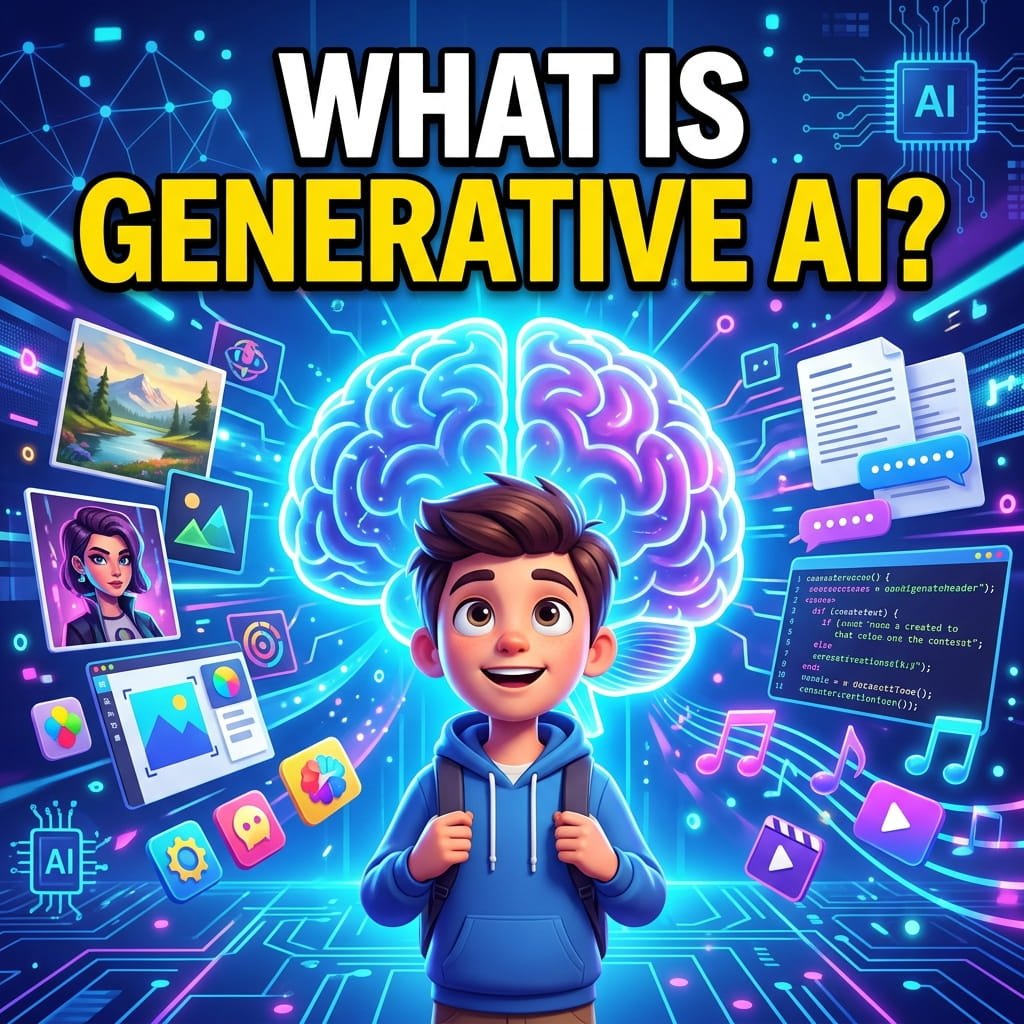
At its core, generative AI is a type of artificial intelligence that creates new, original content in response to a user’s prompt or instruction. That content can be text, images, video, audio, computer code, or even 3D models — content that didn’t exist before you asked for it.
The word “generative” is the key. Unlike traditional AI systems that classify, sort, or predict outcomes using existing data, generative AI produces something new. Ask it to write a cover letter and it writes one. Ask it to generate an image of a sunset over Tokyo and it creates one from scratch. Ask it to explain quantum physics like you’re five, and it will.
Quick definition: Generative AI (often called Gen AI or GenAI) is artificial intelligence that uses deep learning models to generate original text, images, video, audio, or code based on patterns learned from vast training data.
According to IBM, generative AI “works by identifying and encoding the patterns and relationships in huge amounts of data, and then using that information to understand users’ natural language requests or questions and respond with relevant new content.”
What makes 2026 significant is scale. Gartner projects that more than 80% of enterprises will have deployed generative AI applications by this year — up from less than 5% in 2023. This isn’t a niche technology anymore. It’s infrastructure.
How Does Generative AI Work?
You don’t need a computer science degree to understand this. Here’s the honest, plain-language version.
Training on Massive Datasets
Every generative AI model starts with training. Engineers feed it enormous amounts of data — billions of web pages, books, images, code repositories, scientific papers, and audio recordings. The model doesn’t memorize this data; instead, it learns the statistical patterns within it.
For a text model, this means learning which words tend to follow other words, which concepts relate to which ideas, and how language flows in different contexts. For an image model, it learns what combinations of pixels form recognizable objects, styles, and scenes.
This training happens on enormous computing clusters powered by specialized chips — NVIDIA’s GPUs dominate this space. Training a frontier model like GPT-5 or Gemini costs tens of millions of dollars in compute alone.
The Transformer Architecture
The technical breakthrough that made modern generative AI possible was a paper published in 2017 called “Attention Is All You Need.” It introduced the transformer architecture — the engine inside virtually every major AI language model today.
Before transformers, AI models processed text one word at a time, left to right. Transformers changed this by processing entire sequences simultaneously and using an “attention mechanism” to determine which parts of the input are most relevant to each other. This allows the model to understand context over long passages — which is why ChatGPT or Claude can follow a nuanced multi-paragraph conversation without losing the thread.
From Your Prompt to a Response
When you type a prompt, here’s what happens:
- Your text is broken into small units called tokens (roughly one token per word)
- The model converts these tokens into numerical representations it can process
- It uses its learned patterns to predict the most statistically appropriate next token
- It generates tokens one by one, each informed by what came before
- The resulting sequence of tokens is decoded back into readable text (or rendered as an image, audio clip, etc.)
For image generation, the process is slightly different — diffusion models start from random noise and progressively refine it toward a coherent image that matches your text description, through hundreds of iterative steps.
Foundation Models and LLMs
Two terms you’ll encounter constantly:
- Foundation model: A large, pre-trained model that can be adapted to many downstream tasks. Examples include GPT-5 (OpenAI), Claude (Anthropic), Gemini (Google), and Llama (Meta).
- Large Language Model (LLM): A foundation model specifically trained on text. LLMs power the text generation capabilities of ChatGPT, Claude, and Gemini — but not all generative AI is an LLM. Image and video generators are also generative AI but use different architectures.
The distinction matters because people sometimes use “LLM” and “generative AI” interchangeably — they’re related but not identical.
Types of Generative AI
Generative AI isn’t one thing — it’s a family of technologies, each designed to create a different type of content.
Text Generation (Large Language Models)
This is the category most people have encountered. Text-based generative AI can write essays, summarize documents, answer questions, draft emails, translate languages, generate code, and hold natural conversations.
It works through autoregressive prediction — the model generates one token at a time, each choice influenced by everything that came before it. The sophistication of modern LLMs means outputs are often indistinguishable from human writing.
Leading tools in 2026: ChatGPT (OpenAI / GPT-5 series), Claude (Anthropic), Gemini (Google), Perplexity (for research with citations).
If you’re trying to decide which text AI to use, our ChatGPT vs Claude vs Gemini comparison breaks down the strengths of each.
Image Generation (Diffusion Models)
Text-to-image models accept a written description and generate a matching visual from scratch. The dominant technique uses diffusion — a process of gradually refining a noisy image toward a coherent output.
The quality of AI-generated images has advanced dramatically. In 2026, the line between AI art and professionally produced photography or illustration is increasingly blurred.
Leading tools in 2026: Midjourney V7 (best for artistic quality), Stable Diffusion 3.5 (open-source, maximum control), GPT-Image 1.5 (best for text within images).
If you want to explore this creatively, see our guide to AI art tools for creators or check out the best AI-powered infographic generators for business use.
Video Generation
The newest and fastest-developing category. Text-to-video models can generate short clips from written descriptions, with control over camera angles, motion, and even lighting.
In 2026: Google’s Veo 3.1 leads the category, offering 1080p output with native audio generation. Runway Gen-4 excels at cinematic motion control. Kling 3.5 is preferred for rapid iteration. (Note: OpenAI’s Sora 2 was discontinued in April 2026.)
The practical applications are growing quickly — from marketing content to educational explainers. Our roundup of AI video editing tools for beginners is a good starting point if you want to explore this.
Audio and Music Generation
Tools like Suno and Udio can now generate complete, professionally-sounding songs — with lyrics, instrumentation, and vocals — from a simple text prompt. This includes:
- Music composition and production
- Text-to-speech and voice synthesis
- Voice cloning (with significant ethical questions attached)
- Sound design for games and film
Copyright remains an unresolved legal question in this space — the industry is still waiting for definitive rulings on AI-generated music that draws from copyrighted training data.
Code Generation
AI coding assistants have moved from novelty to professional standard. GitHub Copilot is now deployed across 90% of Fortune 100 companies. Tools like Claude Code and Cursor can write, explain, and debug code from natural language descriptions.
A concept called “vibe coding” — building full applications through conversational prompts rather than writing traditional code — was named a 2026 breakthrough by MIT Technology Review. This has lowered the barrier to software development significantly for non-technical users.
Multimodal AI
Modern frontier models don’t just handle one type of content — they work across text, images, audio, and video simultaneously. This is multimodal AI, and it’s become the standard expectation for top-tier models.
Practical examples: uploading a photo of a dish and asking for the recipe, sending a PDF and asking for a summary, recording a voice note and getting a written analysis. The Stanford AI Index reported 40% improvements in cross-modal reasoning from 2024 to 2025 models — the pace of progress here is significant.
Popular Generative AI Tools in 2026
Here’s a practical overview of where to start, organized by use case:
| Category | Best Tool | Best For |
|---|---|---|
| Text / Chat | ChatGPT (GPT-5.5) | Broadest general capability |
| Text / Research | Claude (Anthropic) | Long documents, nuanced reasoning |
| Text / Search | Perplexity | Cited research and fact-checking |
| Image | Midjourney V7 | Artistic and marketing quality |
| Image (open-source) | Stable Diffusion 3.5 | Full creative control |
| Video | Google Veo 3.1 | Cinematic quality, native audio |
| Code | Claude Code / Copilot | Development assistance |
| Productivity | Microsoft Copilot | Microsoft 365 integration |
For everyday professional use, AI tools are also transforming how people handle email. If you spend too much time writing responses, explore AI email assistants that save hours every week — or try a quick demo with our AI email reply generator to see what AI-assisted writing feels like in practice.
Real-World Applications of Generative AI
The use cases for generative AI span virtually every professional field. Here are the most significant.
Business and Marketing
Content production has been transformed. A HubSpot report found that 44% of marketing content in 2025 was created with AI assistance — covering blog posts, ad copy, product descriptions, email campaigns, and social media content.
AI tools are especially valuable for scaling content without sacrificing quality. Brands use them to maintain a consistent voice across dozens of channels simultaneously.
If you create content for platforms like YouTube or TikTok, AI tools for writing video scripts can dramatically speed up production.
Healthcare and Life Sciences
Medical researchers are using generative AI to:
- Generate synthetic medical images that expand training datasets for diagnostic AI
- Assist with drug discovery (Gartner estimated 30% of newly discovered drugs would involve AI by 2025)
- Draft clinical documentation and patient-facing communications
- Summarize complex research papers for clinicians
Human oversight remains essential here — hallucinations in a medical context carry real-world risk. But used as an assistive layer, GenAI is genuinely accelerating research timelines.
Education
Adoption in education is striking. The Stanford AI Index reports that 86% of education sector organizations use AI — driven primarily by content creation, personalized tutoring, and learning support tools.
Students use AI to summarize readings, practice problem sets, and get explanations tailored to their level. Educators use it to generate quiz questions, differentiate lesson materials, and reduce administrative load. If you’re looking to build skills using AI tools, our guide to AI platforms for online skill building is worth reading.
Finance and Investment
Financial services firms spend over $20 billion annually on AI. Applications include:
- Market analysis and pattern recognition
- Risk modeling and scenario generation
- Regulatory report summarization
- Fraud detection support
Our deeper guide on how AI can improve investment decisions explores this further.
Small businesses aren’t left out either — the best AI analytics tools for small businesses bring capabilities once reserved for enterprise finance teams to independent operators.
Software Development
AI has become a standard layer in software development. GitHub Copilot alone serves over 90% of Fortune 100 companies. Microsoft CTO Kevin Scott has predicted that AI will write 95% of code by 2030, with senior developers using it as a “force multiplier.”
Benefits of Generative AI
Productivity That Shows in the Numbers
The efficiency gains from generative AI are measurable. MIT studies show AI tools increase writing speed by 40%. McKinsey’s Global AI Survey from 2025 found that organizations achieved an average 5.8× return on investment within approximately 14 months of deployment — with average gains of 15.2% cost savings and 22.6% productivity improvement.
These aren’t projections; they’re reported outcomes from deployed systems.
Democratizing Professional-Quality Output
Perhaps the most significant social impact of generative AI is what it enables for non-specialists. A small business owner can now produce professional marketing visuals without hiring a designer. A first-generation student can get personalized tutoring without a private tutor. An independent developer can build functional apps without a full engineering team.
This democratization of capability is real — and it’s compressing decades of skill-gap inequity.
Accelerating Research and Innovation
Generative AI compresses research timelines. In drug discovery, scientific writing, materials science, and legal research, AI can synthesize existing knowledge and surface insights that would take human teams months to identify. The World Economic Forum has consistently cited AI’s potential to accelerate solutions to complex global challenges — from climate modeling to pandemic preparedness.
Personalization at Scale
AI enables one-to-one communication at one-to-many scale. Personalized emails, adaptive learning modules, individualized customer service — all become feasible when AI can generate content tailored to each user without manual effort.
Limitations and Challenges of Generative AI
Understanding what generative AI can’t do reliably is as important as knowing what it can.
Hallucinations — When AI Confidently Gets It Wrong
AI hallucinations are outputs that are plausible-sounding but factually incorrect. A model asked for a citation might invent one that looks real but doesn’t exist. Asked about a recent event, it might describe something that never happened.
This happens because language models predict statistically likely outputs, not verified facts. They don’t “look things up” in real time unless equipped with external search tools.
Practical implication: Never publish AI-generated factual content without verification. This is especially critical in medical, legal, financial, and journalistic contexts.
Techniques like Retrieval-Augmented Generation (RAG) help mitigate this by grounding model outputs in real-time retrieved documents — but hallucinations remain an open research challenge.
High Computational Cost and Energy Demands
Training frontier models is extraordinarily resource-intensive. Running them at scale has a measurable carbon footprint. As AI becomes embedded in more services, the aggregate energy demand of inference — generating responses — is growing into a meaningful sustainability concern.
The industry is actively working on model compression, distillation, and more efficient architectures to reduce this cost.
Bias Inherited from Training Data
Generative AI learns from human-produced data — which means it also learns human biases. Models can produce stereotyped, culturally insensitive, or discriminatory outputs when those patterns exist in the training data.
This requires ongoing bias auditing and diverse, representative training datasets — an area where progress has been made but significant challenges remain.
The “Black Box” Problem
Generative AI outputs are difficult to trace and explain. When a model produces an answer, it’s often unclear exactly why it chose those particular words or concepts. This lack of interpretability creates challenges in high-stakes settings where accountability and explainability matter — healthcare decisions, legal reasoning, financial recommendations.
Ethical Concerns You Should Know About
Deepfakes and Synthetic Media
The ease of creating photorealistic fake images, videos, and voice clones is one of the most pressing concerns around generative AI. These “deepfakes” can be used to spread political misinformation, commit identity fraud, harass individuals, or fabricate evidence.
Regulatory responses are accelerating: California has moved to restrict election-related deepfakes, and India has proposed rules requiring AI-generated content to carry visible labels covering at least 10% of visual displays.
Detection tools are also improving — but the arms race between generation quality and detection accuracy continues.
Copyright and Intellectual Property
Generative AI models are trained on vast amounts of publicly available data, including copyrighted books, art, music, and code — often without the creators’ permission or compensation. The legal landscape is actively evolving, with multiple lawsuits in progress between AI companies and artists, publishers, and news organizations.
Before using AI-generated content commercially, it’s worth understanding the copyright implications in your jurisdiction.
Data Privacy
When you type sensitive information into an AI prompt — personal details, confidential business data, client information — that data may be stored, used for training, or exposed to other parties, depending on the platform’s terms of service. Our guide on the risks of sharing personal data with AI covers this in practical detail.
Workforce Displacement and New Roles
Generative AI automates tasks previously done by humans — content writing, basic customer service, code review, data analysis. While the long-term net effect on employment is genuinely debated, the short-term disruption in specific roles is real.
The counterpoint: 30% of enterprises are actively creating new roles specifically to manage, govern, and work alongside their AI systems. Skills like prompt engineering, AI output evaluation, and AI workflow design are growing in demand.
For a broader look at where this is heading, explore the ethical AI trends every user should know in 2026.
Generative AI vs. Traditional AI — What’s the Difference?
People often use “AI” as a blanket term, but generative AI is a specific and distinct approach. Here’s how it compares to traditional AI:
| Traditional (Discriminative) AI | Generative AI | |
|---|---|---|
| Primary function | Classify, predict, or label existing data | Create new, original content |
| Typical outputs | A decision, score, or category | Text, image, audio, video, code |
| Learning approach | Supervised learning on labeled datasets | Self-supervised learning on unstructured data |
| Examples | Spam filters, fraud detection, Netflix recommendations | ChatGPT, Midjourney, Suno |
| Explainability | Generally higher | Generally lower (“black box”) |
| Best used for | High-stakes decisions requiring reliability | Content creation, ideation, summarization |
The simplest mental model: traditional AI is a judge (it evaluates and decides), generative AI is an artist (it creates something new).
Many modern systems combine both — a discriminative model might evaluate the quality or safety of outputs that a generative model produced.
Generative AI Trends in 2026
The Rise of Agentic AI
The biggest shift happening right now is the evolution from reactive tools to agentic AI systems — AI that doesn’t just respond to prompts but can autonomously plan and execute multi-step tasks.
An agentic system can browse the web, write and run code, update databases, send emails, and chain together complex workflows with minimal human intervention. McKinsey reports that 23% of organizations are already scaling agentic AI, with another 39% experimenting. By end of 2026, 40% of enterprise applications are projected to include task-specific AI agents.
This is the shift from “AI assistant” to “AI colleague.”
Multimodal Models Become the Expectation
Processing text, images, audio, and video in a single unified model is now the baseline expectation for leading AI tools, not a premium feature. Gartner projects 80% of enterprise applications will be multimodal by 2030.
Smaller, Specialized Models
Not every use case needs a frontier-scale model. There’s growing demand for compact, efficient models fine-tuned for specific industries — legal research, medical documentation, financial analysis — that can run on-device with lower cost and latency, and without sending data to external servers.
Governance and Regulation
The EU AI Act is in force. US and Indian AI regulatory frameworks are active. More enterprises are building internal AI governance teams, conducting output audits, and documenting AI use in compliance reports. Explainability and accountability are moving from ideals to requirements.
For a forward-looking look at what’s coming, see our roundup of emerging AI technologies to watch in 2026.
The Future of Generative AI
Where does this go from here?
The Economic Scale Ahead
The numbers point to sustained, dramatic growth. The generative AI market is projected to grow from approximately $11 billion in 2025 to $363 billion by 2035 — a compound annual growth rate of roughly 37.5%. McKinsey estimates GenAI could add $2.6–$4.4 trillion annually to global GDP.
Gartner predicts AI agents will intermediate more than $15 trillion in B2B spending by 2028.
Human-AI Collaboration, Not Replacement
The dominant model emerging from enterprise deployments isn’t AI replacing humans — it’s AI multiplying human capability. The most effective organizations are redesigning workflows around AI as a collaborator, not layering it onto unchanged processes.
“Top-tier developers,” said Microsoft CTO Kevin Scott, “will use AI as a force multiplier to enable them to operate with greater efficiency and scope.”
The same pattern is emerging in medicine, law, finance, education, and creative work. The people who adapt quickest — who learn to direct and evaluate AI output effectively — will have a significant advantage.
What to Watch Next
- Physical AI: Generative reasoning embedded in robotics
- Scientific AI: AI-accelerated drug discovery, materials science, climate modeling
- Persistent memory AI: Personal AI assistants that maintain context across months of interaction
- AI-native education: Platforms that adapt in real time to each learner’s progress
Frequently Asked Questions
What is generative AI in simple terms?
Generative AI is a type of artificial intelligence that creates new content — text, images, videos, music, or code — when you give it a prompt. Think of it as a creative assistant that learned from an enormous amount of human-created work and can now produce new things in a similar style.
Is ChatGPT an example of generative AI?
Yes. ChatGPT is one of the most widely used generative AI tools in the world. It’s powered by OpenAI’s GPT-5 series, a large language model that generates text responses based on your prompts.
What is the difference between generative AI and regular AI?
Traditional (or “discriminative”) AI classifies and predicts from existing data — spam filters, recommendation engines, fraud detection. Generative AI creates brand-new content. One sorts; the other creates.
What are the biggest risks of using generative AI?
The main risks are hallucinations (confident but incorrect outputs), data privacy concerns, potential copyright issues, and the risk of deepfakes or misinformation. For practical guidance, see our guide on risks of sharing personal data with AI.
Can generative AI replace human jobs?
It automates specific tasks, particularly in writing, design, and customer service — and this is causing genuine disruption in some roles. But it also creates new demand for people who can direct, evaluate, and govern AI systems. Most evidence from enterprise deployments points to augmentation over replacement for knowledge workers, though the picture varies by industry.
What is an LLM (Large Language Model)?
An LLM is a type of generative AI trained on massive text datasets to understand and generate human language. ChatGPT, Claude, and Gemini are all powered by LLMs. The “large” refers to the enormous number of parameters — mathematical values — the model learns during training, which can reach into the hundreds of billions.
How accurate is generative AI?
It varies significantly by task and model. For drafting, summarizing, and brainstorming, accuracy is generally strong. For precise factual claims, statistics, and citations, outputs must always be verified. Hallucinations — confident but incorrect statements — are a known limitation of all current LLMs.
Is generative AI safe to use for business?
Generally yes, with appropriate precautions. Avoid entering confidential client data, proprietary business information, or personal data into public AI tools. Review outputs before publishing. Understand the terms of service of the tools you use. More organizations are developing internal AI usage policies to address this systematically.
Key Takeaways
- Generative AI creates new content (text, images, video, audio, code) from a prompt — rather than classifying or predicting from existing data.
- It works by training on massive datasets, learning statistical patterns, and generating outputs token by token using transformer-based neural networks.
- The major categories are text (LLMs), image (diffusion models), video, audio, code, and multimodal AI.
- Leading tools in 2026 include ChatGPT, Claude, Gemini, Midjourney V7, Google Veo 3.1, and GitHub Copilot — each with distinct strengths.
- Real-world applications span marketing, healthcare, education, finance, and software development, with measurable productivity gains across all sectors.
- Key risks include hallucinations, data privacy, copyright, and deepfakes — all manageable with informed, responsible use.
- The direction of travel is toward agentic AI systems that plan and execute multi-step tasks autonomously, and multimodal models that work fluidly across content types.
- Human expertise remains central. Generative AI is a force multiplier, not a replacement.
Want to put it in practice? Start by exploring the ChatGPT vs Claude vs Gemini comparison to find the right text AI for your needs — or browse our guide to emerging AI technologies in 2026 to stay ahead of what’s coming next.
Information in this article is based on research verified to June 2026. Sources include IBM, Stanford HAI, McKinsey, Gartner, OpenAI, OECD, MIT, and PwC.